Anonymous - Adam and Eve from the Sarajevo Haggadah (1350)
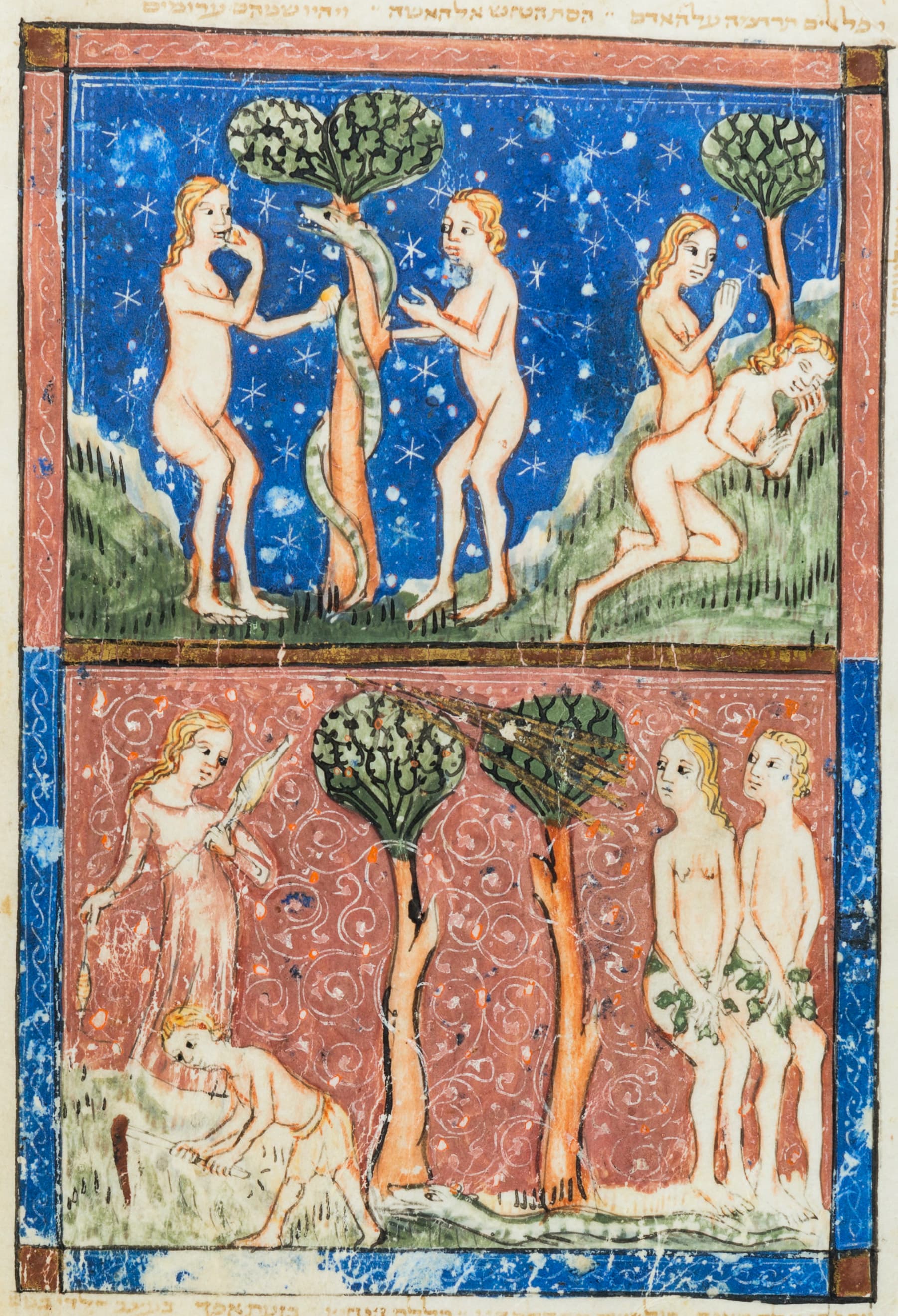
- Title: Adam and Eve from the Sarajevo Haggadah
- Artist: Anonymous
- Date: 1350
- Medium: Ink, copper and gold on bleached calfskin
- Dimensions:
- Location: National Museum, Sarajevo, Bosnia and Herzegovina
The Sarajevo Haggadah is an illuminated manuscript that contains the illustrated traditional text of the Passover Haggadah which accompanies the Passover Seder. A Haggadah is a Jewish text that outlines the order of the Passover Seder, which is a ritual meal that tells the story of the Exodus from Egypt. It is one of the oldest Sephardic Haggadot (plural of Haggadah) in the world, made in Catalonia (current day Spain) around 1350. It is handwritten on bleached calfskin and illuminated in copper and gold. It opens with 34 pages of illustrations of key scenes in the Bible from Creation through the death of Moses. In the Sarajevo Haggadah, Adam and Eve appear in a compact series of miniatures that narrate the Garden of Eden story almost like a medieval comic strip. The manuscript opens its biblical cycle with Genesis scenes, including the Creation of Eve, the temptation, the realization of nakedness, and the expulsion from Eden.
On the Garden of Eden page, Adam and Eve are shown as slim, youthful figures with reddish-blond hair, standing or reclining in a stylized garden under a single tree. Their bodies are smooth and idealized—without navels—reflecting conventions borrowed from contemporary Christian manuscripts and courtly art. Eve is literally drawn emerging from Adam’s side as he sleeps on the grass, then the pair appear beside the Tree of Knowledge as Adam eats the forbidden fruit while Eve and the serpent look on. In a later panel, they hastily cover themselves with fig leaves after realizing they are naked, and finally they are pictured outside Paradise: Adam bent over the earth in hard labor, Eve fully clothed and holding a distaff, beginning a life of work and pain.
The setting is not a naturalistic garden but a richly patterned, almost textile-like space. The backgrounds are checkerboards of blue and rose squares filled with tiny stars and arabesques, evoking Islamic tilework from al-Andalus; intense reds, blues, greens, and yellows make the scenes glow on the vellum. In the panel where Adam and Eve hide, rays of light slant down toward them from above the tree—a brilliant visualization of “the voice of God walking in the garden,” so that divinity is suggested only as light rather than a figure, in deference to the prohibition on images of God.
Taken together, these Eden scenes fuse Jewish scriptural sensitivity with Christian pictorial models and Islamic decorative taste. They turn the Garden of Eden into a vivid, emotionally legible story of innocence, desire, shame, and exile—motifs that resonate deeply in a book made for a Sephardic community that would itself soon experience expulsion from its own earthly “paradise” in Spain.
--
- UNESCO: Sarajevo Haggadah Mansucript
- On the Met website: Insights on various Haggadot
- In the Bezalel Narkiss Index of Jewish Art and Material Culture: Sarajevo Haggadah Mansucript