Franz von Stuck - Springtime of Love (1917)
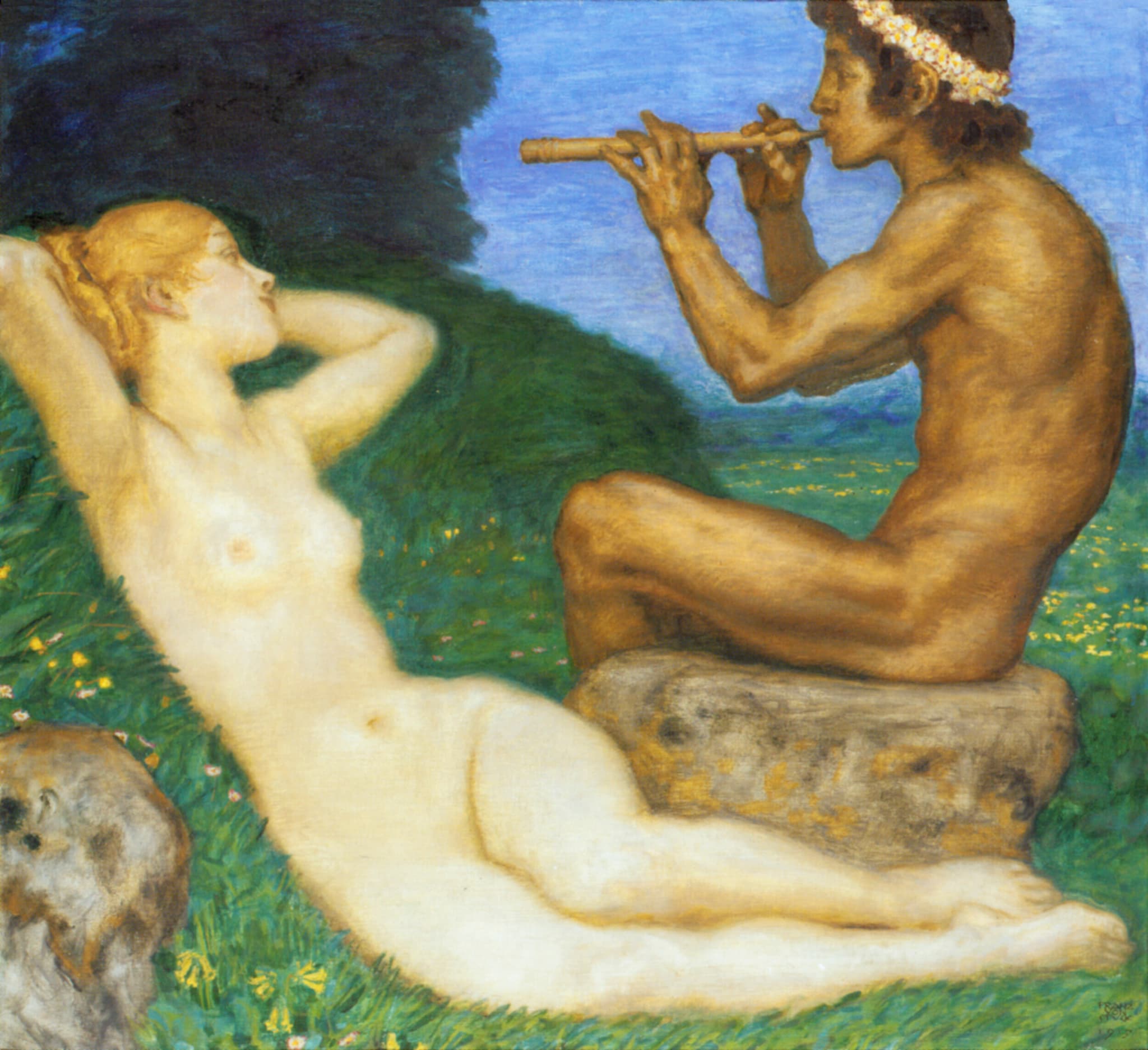
- Title: Springtime of Love (Liebesfrühling)
- Artist: Franz von Stuck (1863-1928)
- Date: 1917
- Medium: Oil on canvas
- Dimensions: 106 x 116 cm
- Location: Private collection, unknown location
- Photo credit: uploaded by Sebastian Nizan on Wikimedia in 2011
- Seen: sold by auctioneer Christie's and displayed online on christies.com
Franz von Stuck's "Springtime of Love" (Liebesfrühling, 1917) depicts a beautiful nymph, reclining naked in a verdant landscape, listening to a garlanded youth playing a pipe. They are at once at ease with each other and with the countryside around them. It is a scene of harmony and sensual abandonment. Von Stuck frequently depicted a mythological world populated with nymphs and centaurs, baccantes and fauns. It was a playful world with distinctly comic and erotic undertones.
"Springtime of Love" shows a nude couple in a lush, secluded landscape, rendered in the soft, atmospheric manner typical of late Symbolism. A young woman reclines on the grass, her pale body stretched along a gentle diagonal, framed by dark foliage and soft undergrowth. Nearby sits a garlanded youth, also nude, absorbed in playing a pipe. The scene feels at once intimate, as if we have stumbled upon a private moment in some mythic woodland clearing.
Stuck carefully balances sensuality and calm. The woman’s pose is relaxed and seductive: one arm supports her head, the other lies along her body, and her gaze is directed not at us but toward her companion or simply into the warm air of the scene. The youth’s posture, focused on his music, keeps the encounter from becoming a straightforward seduction; what we see instead is a kind of shared reverie. Their bodies are modeled with a sculptor’s eye—Stuck was also a sculptor—so that muscles and curves catch the light softly, creating a creamy, almost glowing surface against the deeper greens and browns of the trees.
The setting completes the mood of “springtime”: a verdant grove that reads less as a specific place than as an allegory of youth, desire, and natural harmony. Stuck’s muted yet rich palette, and the way he lets forms dissolve slightly at the edges, gives the painting a dreamlike quality, as though the figures might be nymph and shepherd rather than ordinary mortals. In this way, "Springtime of Love" fits neatly into his larger mythological world of nymphs, fauns, and sensuous woodland scenes, where eroticism is softened by symbolism and by a nostalgic longing for an imagined golden age of innocence and pleasure.