Georgiana Houghton - The Portrait of the Lord Jesus Christ (1862)
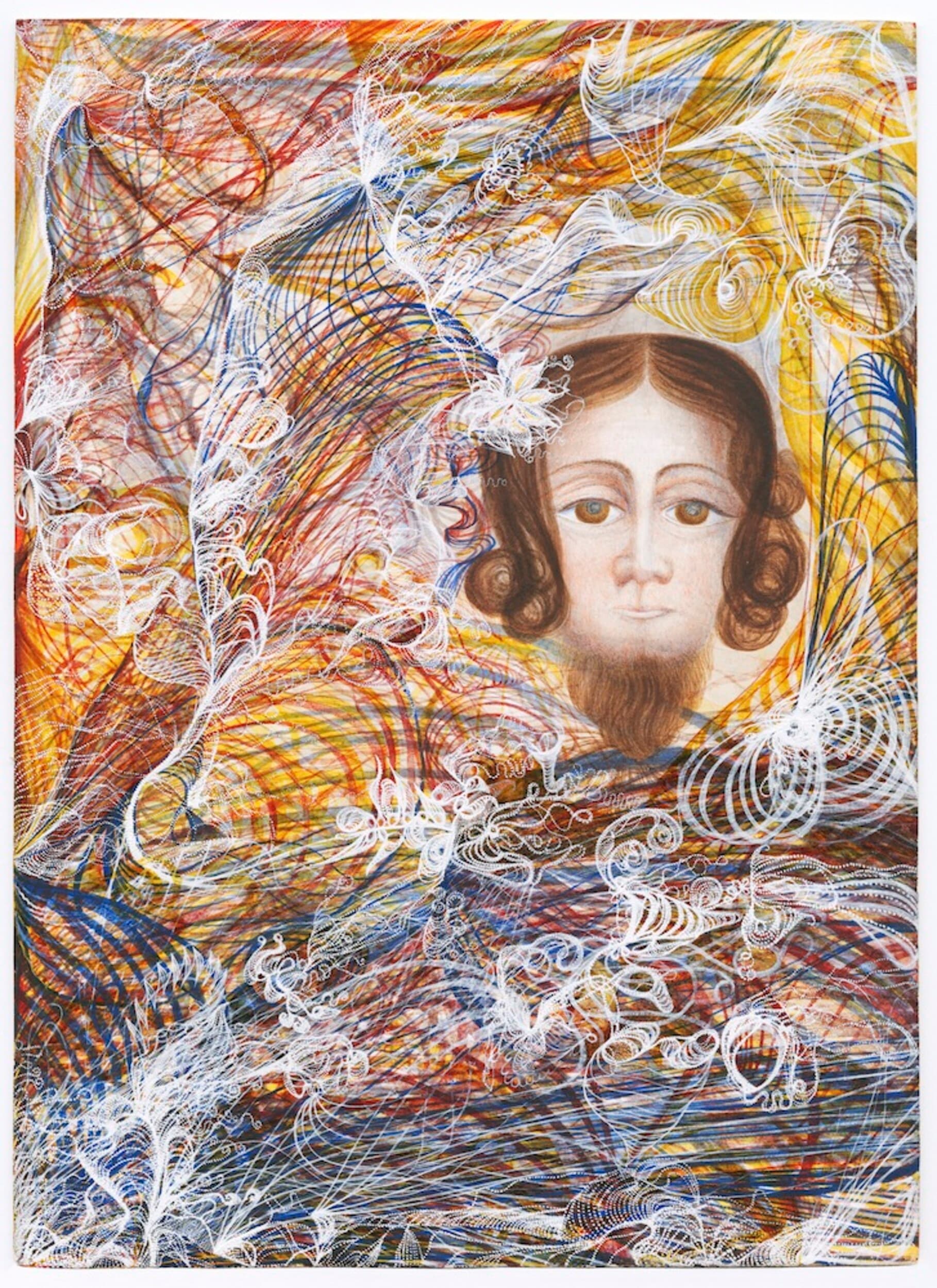
- Title: The Portrait of the Lord Jesus Christ
- Artist: Georgiana Houghton (1814-1884)
- Date: 1862
- Medium: Watercolor and gouache on paper laid on board
- Dimensions: 33 x 24 cm
- Location: Victorian Spiritualists' Union, Melbourne, Australia
Georgiana Houghton’s "The Portrait of the Lord Jesus Christ" is a small but intense watercolour and gouache drawing. It looks mostly abstract: a dense sheet of layered reds, golds, violets and browns, built from fine, looping lines and translucent washes. However, out of this web a pale oval face emerges, with large eyes, a straight nose and a soft beard. Rather than sitting in a realistic setting, Christ’s features seem to crystallize out of an energetic field of marks, as if spirit were condensing into visibility.
The context is Victorian Spiritualism. Houghton was a British artist and medium who believed she worked under the direct guidance of spirits and saints, using a kind of controlled automatism whereby she produced “spirit drawings”, non-figurative compositions that she called “sacred symbolism” where every colour and line had a spiritual meaning.
"The Portrait of the Lord Jesus Christ" is said to be exceptional within this body of work: whereas other paintings are non-figurative compositions, this one is both figurative and non-figurative. The drawing is not meant to be a portrait from life but a visualization of Christ as pure spiritual presence, made manifest through guided marks. The fact that his face only gradually becomes legible out of the surrounding spirals mirrors her belief that art could make the invisible world perceptible to the material eye.
In the twentieth and twenty-first centuries, "The Portrait of the Lord Jesus Christ" has become a key image in the rediscovery of Houghton as a precursor of abstraction, predating Kandinsky.
--
- At Courtauld Gallery: Past exhibition on Georgiana Houghton
- On Wikipedia: Georgiana_Houghton