Grant Wood - American Gothic (1930)
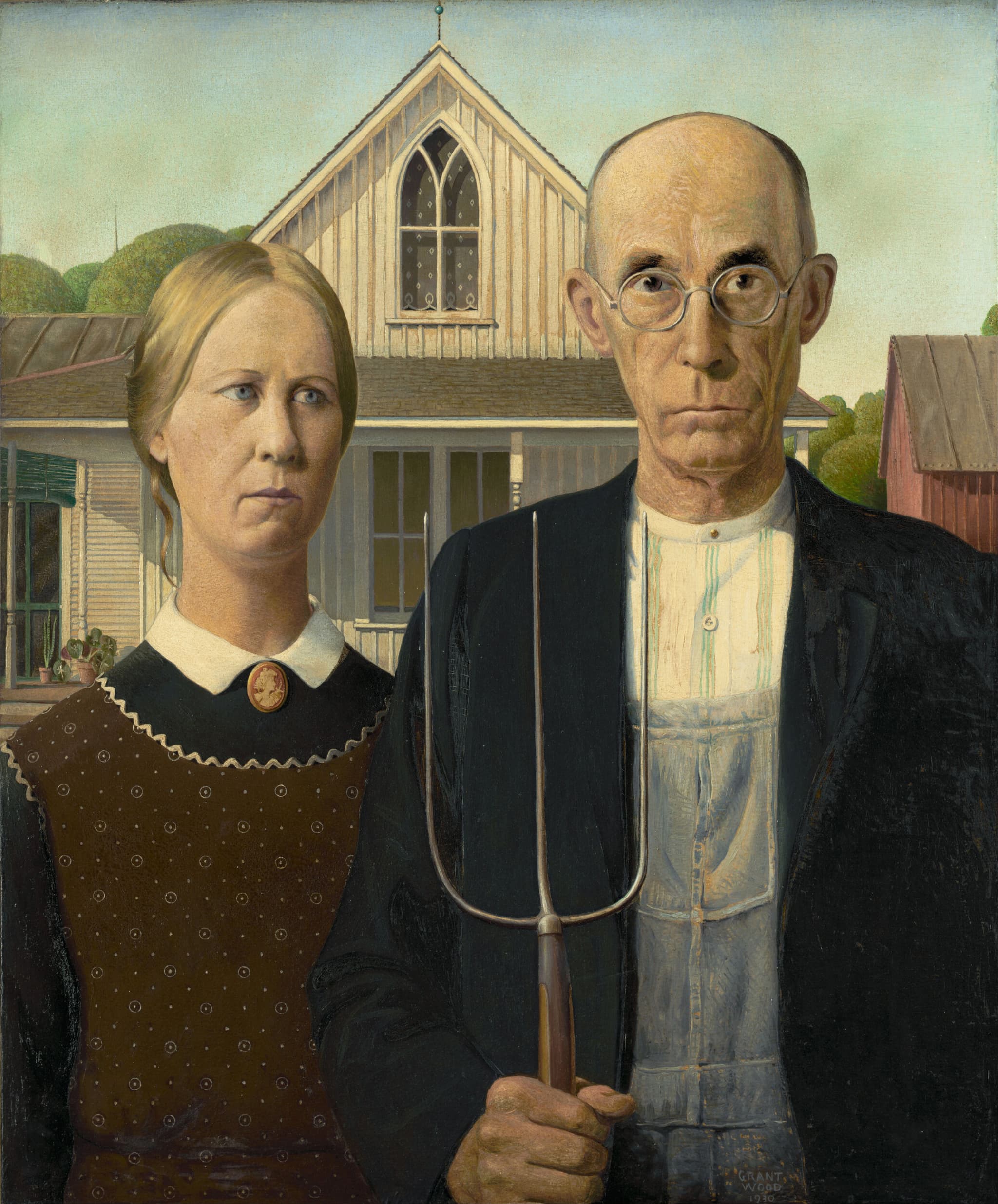
- Title: American Gothic
- Artist: Grant Wood (1891-1942)
- Date: 1930
- Medium: Oil on beaverboard
- Dimensions: 78 × 66 cm
- Location: Art Institute of Chicago, Chicago, USA
- Photo credit: Google Arts & Culture on Wikipedia
Grant Wood’s "American Gothic" shows a stern, unsmiling man and woman standing in front of a small white farmhouse with a pointed Gothic window. The man, thin with wire-rimmed glasses, grips a three-pronged pitchfork making him to be a farmer. The pitchfok lines up with the vertical seams of his overalls and the stripes of his shirt. Beside him, the woman turns slightly toward him yet looks off to the side, her lips pressed tight. Their dark, old-fashioned clothes and rigid posture make them look as if they’ve stepped out of a 19th-century tintype, frozen in place.
Behind them rises a Carpenter Gothic house that gives the painting its title, with its tall, arched window and sharply pitched roof. Carpenter or Rural Gothic is an architectural style applied to wooden structures, commonly seen in small houses and churches in North America during the late 19th century.
In this painting, the building is meticulously rendered, as are the crisp lines of the clapboards, the neat curtains, and the carefully trimmed greenery in the yard. Everything feels controlled and orderly: the furrows of the land, the verticals of the house and pitchfork, even the pattern of the woman’s dress. This precision contributes to the painting’s tense, hyper-real atmosphere inspired in part by Northern Renaissance painting such as Flemish primitives Robert Campin or Jan van Eyck.
The mood of "American Gothic" is famously ambiguous. Some viewers see it as a loving tribute to Midwestern resilience and rural values, painted just after the 1929 crash when many Americans longed for stability. Others read it as a sly satire of small-town narrowness and rigidity, pointing to the pinched expressions and stiff poses as evidence that Wood is gently mocking his subjects. The painting’s power comes from this uncertainty: it can be both sympathetic and ironic at the same time, depending on who is looking.
Since its first showing in 1930, "American Gothic" has become one of the most recognized images in American art. Seen in person, its small scale and fine detail contrast with its huge cultural footprint, distilling an entire mythology of “Middle America” into a single, unforgettable, modern icon.
--
- At Art Institute of Chicago: Grant Wood - American gothic
- On Wikipedia: Grant Wood - American gothic
- On Google Arts & Culture: Grant Wood - American gothic