Hans Baldung Grien - The Crucifixion of Christ (1512)
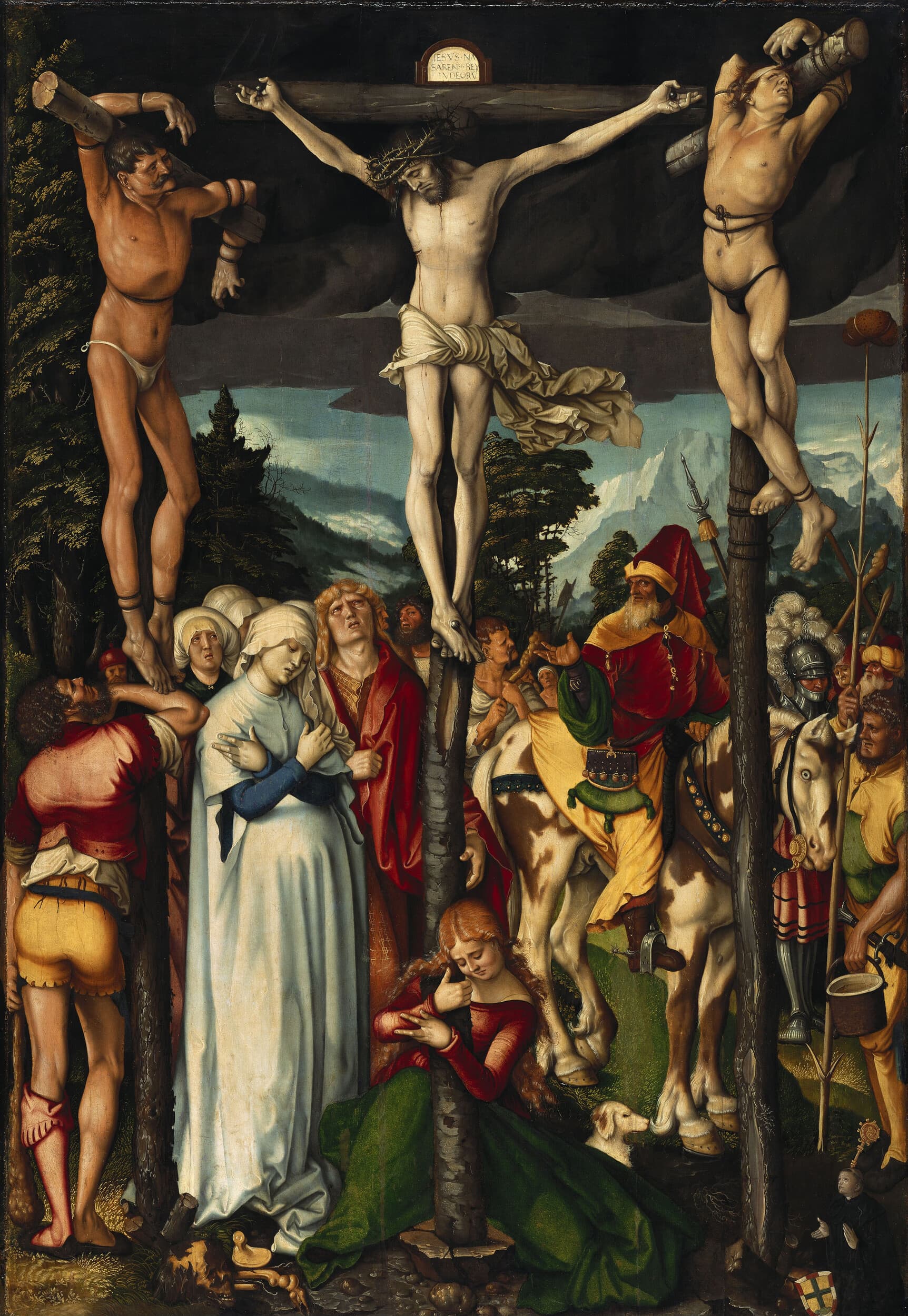
- Title: The Crucifixion of Christ (Die Kreuzigung Christi)
- Artist: Hans Baldung Grien (1485-1545)
- Date: 1512
- Made in: Strasbourg (current France)
- Medium: Oil on linden wood
- Dimensions: 151 x 104 cm
- Location: Gemäldegalerie, Berlin State Museums, Berlin, Germany
- Photo credit: Google Arts & Culture on Wikipedia
Hans Baldung Grien’s "The Crucifixion of Christ" is a 1.5 meters high panel in oil on wood. Christ’s cross dominates the center, flanked by the two thieves, while a tightly packed crowd in contemporary Renaissance dress presses in below. Baldung, one of the most important German Renaissance painters and the most gifted pupil of Albrecht Dürer, uses this familiar subject to show how far Northern art has moved toward a new, powerfully individual style.
The composition is quite strange with three areas: at the top Chirst and the two thieves on their respective crosses, at the bottom a small crowd, cramped together, around the base of each cross, and in the background white mountains standing tall with, even higher, an empty, lunar-like world.
Christ is unnaturally pale, almost luminous against a pitch-dark sky, while the thieves twist in contorted poses that feel both anatomically observed and deliberately distorted. Soldiers, Mary, John, and Mary Magdalene are all dressed like Baldung’s own contemporaries, anchoring the biblical drama in the world his viewers knew. The composition is organized as a careful mesh of verticals and horizontals—the three crosses, the spears, the line of the hill—creating a strong structural grid that holds together all this movement and emotion.
This blend of strict structure and emotional excess is exactly why the work matters in the history of German Renaissance art. Baldung stands at the crossroads between late Gothic intensity and Renaissance interest in the body, space, and natural light. Art historians describe him as part of the Upper Rhine style, combining Dürer’s precision with a more visionary, even unsettling imagination. In "The Crucifixion of Christ", you see that synthesis clearly: the careful perspective and solid anatomy belong to the Renaissance, while the exaggerated poses, dark atmosphere, and almost mystical mood recall the older medieval taste for the dramatic and the uncanny.
Within the small circle of major German Renaissance masters (Dürer, Cranach, Grünewald, Altdorfer) Baldung is the one who pushes religious imagery toward the edge of Mannerism and emotional extremity. This Crucifixion, painted around the time he was working on his great Freiburg cathedral altarpiece, shows how German artists adopted the Renaissance language without losing their distinctive, highly charged spirituality. Hence, the panel is a key document of how the German Renaissance forged its own path, parallel to, but not imitating, Italian Renaissances.
--
- At Staatliche Museen zu Berlin: Hans Baldung Grien - The Crucifixion of Christ
- On Google Arts & Culture: Hans Baldung Grien - The Crucifixion of Christ