Henri-Edmond Cross - Running Nymphs (c.1906)
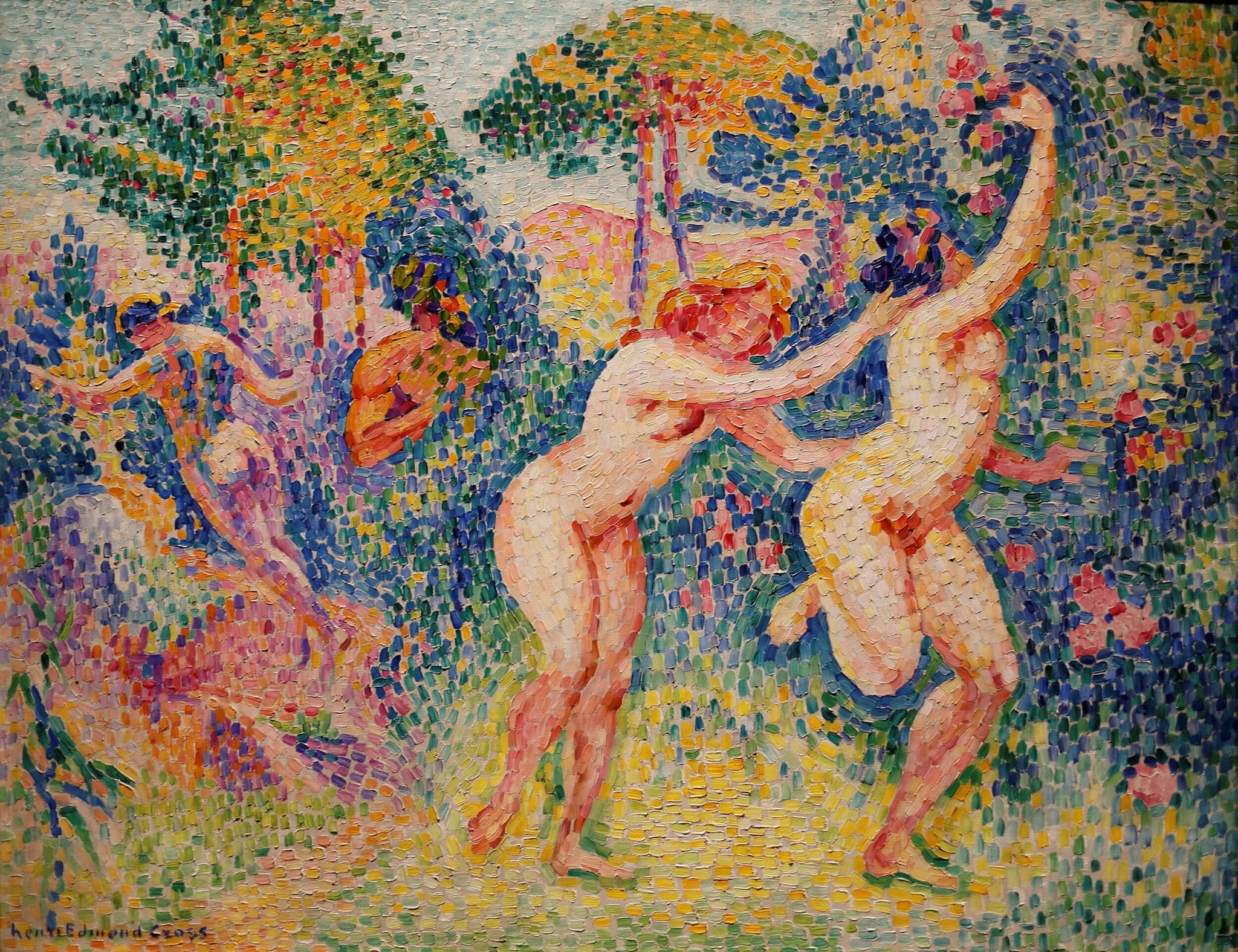
- Title: Running Nymphs (La fuite des nymphes)
- Artist: Henri-Edmond Cross (1856-1910)
- Date: c.1906
- Medium: Oil on canvas
- Dimensions: 73 x 92 cm
- Location: Musée d'Orsay, Paris, France
- Photo credit: RMN-Grand Palais (Musée d’Orsay) / Hervé Lewandowski
Henri-Edmond Cross’s "The Running Nymphs" known by its original French title, "La fuite des nymphes", painted around 1906. The scene shows two nude nymphs running side by side through a luminous natural setting, their elongated bodies stretched in mid-stride so that they seem to skim across the ground. Cross turns the subject into an airy, almost dreamlike episode in a modern, Mediterranean landscape.
The composition is built from countless small touches of paint in the Neo-Impressionist manner. Cross uses tight pointillist or divisionist strokes to construct the foliage, ground, and sky, so that the whole surface flickers with light. The nymphs’ bodies are modeled with warm oranges, pinks, and yellows that stand out against cooler greens and blues in the wooded background, a contrast that makes their movement feel even more vibrant. Instead of sharp outlines, their forms are edged by fields of color that seem to vibrate, as if they were dissolving into the air around them.
The nymphs are shown in full flight, arms and legs extended, hair and limbs echoing the curves of the surrounding vegetation. Their nudity reads as a kind of natural innocence, not academic display: they embody freedom, joy, and an almost musical rhythm rather than narrative drama. Contemporary descriptions emphasize the sense of “fluid movement” and dancing through an “enchanted forest”; Cross uses shimmering color rather than facial expression to convey that light, ecstatic energy. Is that part of a man's body, like Pan, in the middle of the composition? Maybe the reason of the nymphs' flight?
This painting belongs to Cross’s late Provençal period, when he turned again and again to sun-drenched seascapes and Arcadian nudes, using Neo-Impressionist color to imagine a utopian, liberated world.
This painting makes us think of Matisse's "Joy of Life" (Luxe, calme et volupté) by the colors used and Matisse's "Dance 1" by the flow of the bodies dancing.
--