Hieronymus Bosch - The Garden of Earthly Delights (c.1490-1510)
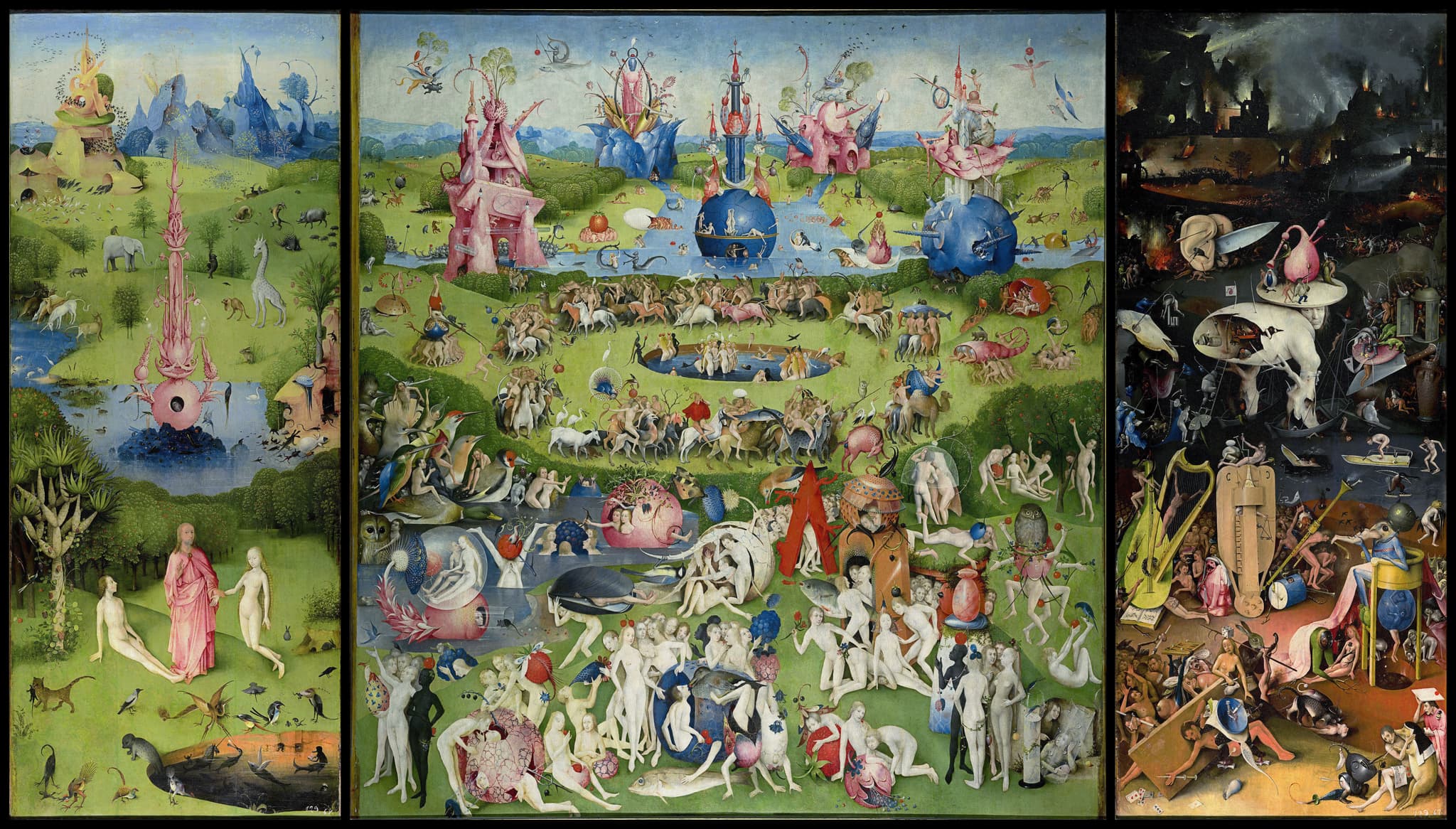
- Title: The Garden of Earthly Delights
- Artist: Hieronymus Bosch (c.1450-1516)
- Date: c.1490-1510
- Made in: Hertogenbosch, Duchy of Brabant, Burgudian Netherlands
- Medium: Oil on oak panel triptych
- Dimensions: 206 × 385 cm
- Location: Museo del Prado, Madrid, Spain
- Photo credit: Google Arts & Culture on Wikimedia
The outside wings (when the triptych is closed) figure a globe representing the planet Earth during Creation as explained in the Genesis, probably on Day 3- after light (day 1), the atmosphere (day 2), and dry ground and plant life (day 3) but before the addition of the sun (day 4), animals and humans (day 5 and 6).
The open triptych probably reads from left to right like a giant storybook with three pages side by side. Bosch did not explain the meaning he gave to his imaginative scenes and symbols.
The left panel shows the moment after Eve is created, when she is brought unto the man by God (cf. Genesis 2.22). You see a delicate, almost peaceful vision of the world’s beginning: God, Adam, and Eve in a strange, crystalline paradise. The colors are fresh and cool, with transparent lakes, odd pink buildings, and carefully painted animals that feel half-real, half-dreamed. It’s Eden, but even here there’s something slightly uncanny, as if temptation is already in the air.
In the middle panel, the viewer sees how a Paradise on Earth would be like- bliss, communion with other humans and Nature, plentifulness, satisfaction of all senses, sexual pleasure. It is a huge, chaotic garden packed with naked figures, giant fruit, birds, and bizarre structures that look like living architecture. Everyone seems busy with pleasure—touching, playing, riding animals, sliding in and out of shells and bubbles. The scene is bright and playful, even funny at first glance, like a surreal theme park. But if you linger, you start to feel uneasy: there’s so much going on that it becomes almost overwhelming, as if this world of endless delight is tipping into excess.
Then on the right panel is a degenerate world of destruction, persecution and of domination of mankind by animals and nature. Everything turns dark. This panel shows a nightmarish Hell, lit by eerie fires and filled with tortured bodies, strange hybrid creatures, and instruments turned into tools of punishment. A huge “tree-man” with a broken eggshell body and hollow gaze stares out at us, and ruined buildings collapse in the background. The same imagination that created the playful garden now invents inventive forms of cruelty, suggesting that pleasure without limits has consequences.
Is that progression an inevitable outcome for Humankind? Or, is it the typical outcome of an individual’s life from innocence to corruption? Or, is it a dire warning to stay in check with religion or with government?...
--
- Explore the inside panels in minute detail with great audio commentaries through an interactive documentary: Hieronymus Bosch - The Garden of Earthly Delights
- On Wikipedia: Hieronymus Bosch - The Garden of Earthly Delights
- On Google Arts & Culture: Hieronymus Bosch - The Garden of Earthly Delights