Mary Cassatt - The Child’s Bath (1893)
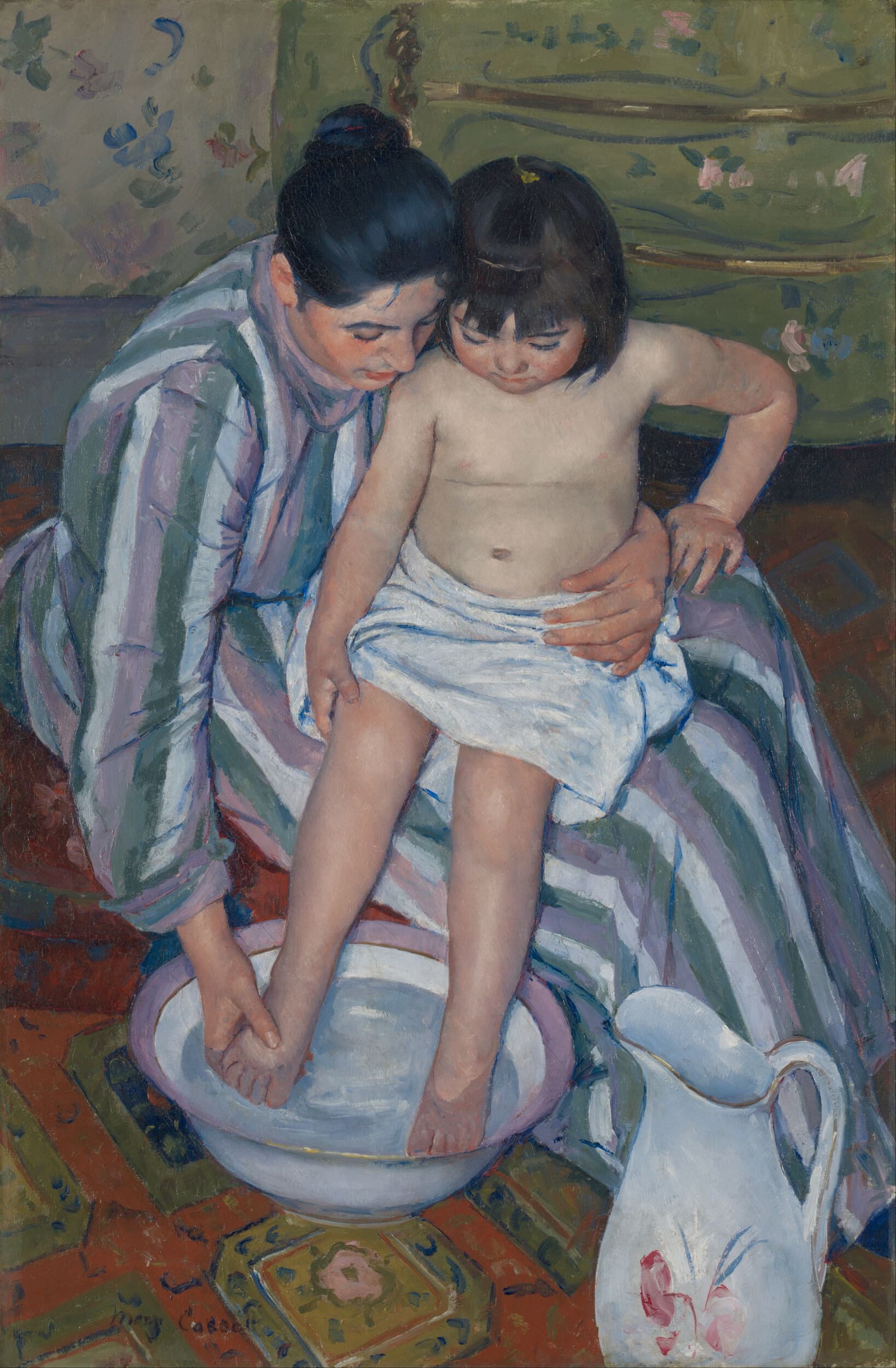
- Title: The child’s bath*
- Artist: Mary Cassatt (1844-1926)
- Date: 1893
- Made in: Paris, France
- Medium: Oil on canvas
- Dimensions: 100 x 66 cm
- Photo credit: Google Arts & Culture
Mary Cassatt’s "The Child’s Bath" is a rigorously composed, intimate scene drawn from everyday life, presented with the gravity once reserved for history painting. We look down into a private domestic ritual—an adult washing a child—rendered without sentimentality or theatrical effect. Cassatt, an American working in France and closely aligned with the Impressionists, makes the familiar feel newly observed: not a cute anecdote, but a considered study of care, touch, and attention.
The steep, almost overhead viewpoint pulls us close, while the figures lock into a compact geometry that keeps our eye moving—arm to hand, hand to foot, foot to basin, basin back to face. Patterns do quiet but insistent work here: the striped dress, the flowered wallpaper, the checked rug. Rather than dissolving form, as Impressionism often does, Cassatt uses pattern to anchor the scene and to emphasize that this is a constructed image—carefully designed, not casually glimpsed. Both the subject matter and the overhead perspective were inspired by Japanese Woodcut prints and Edgar Degas.
Cassatt’s color and handling deepen that sense of purposeful intimacy. The palette is restrained and harmonized, with warm flesh tones and muted blues and mauves that keep the mood calm and concentrated. Brushwork is confident but not showy; the paint describes textures—skin, fabric, porcelain—without distraction. Most importantly, Cassatt gives weight to touch. The adult’s hands are firm and protective; the child’s body is relaxed yet present, not idealized. It is tenderness, yes, but also competence and routine—care as practiced labor.
The painting also carries Cassatt’s larger project: to depict women’s lives with dignity and psychological presence, while expanding what modern art could claim as worthy subject matter. Domestic space here is not a decorative backdrop; it’s a site of relationship and power—who holds, who steadies, who learns. And while the scene is private, the composition is public in its ambition: Cassatt transforms an ordinary bath into a modern icon of embodied care, inviting us to consider how intimacy is built through repeated acts, quietly and every day.
--
- On [Mary Cassatt - The Child’s Bath](Wikipedia https://en.wikipedia.org/wiki/The_Child's_Bath)