Theo van Doesburg - Pure Painting (1920)
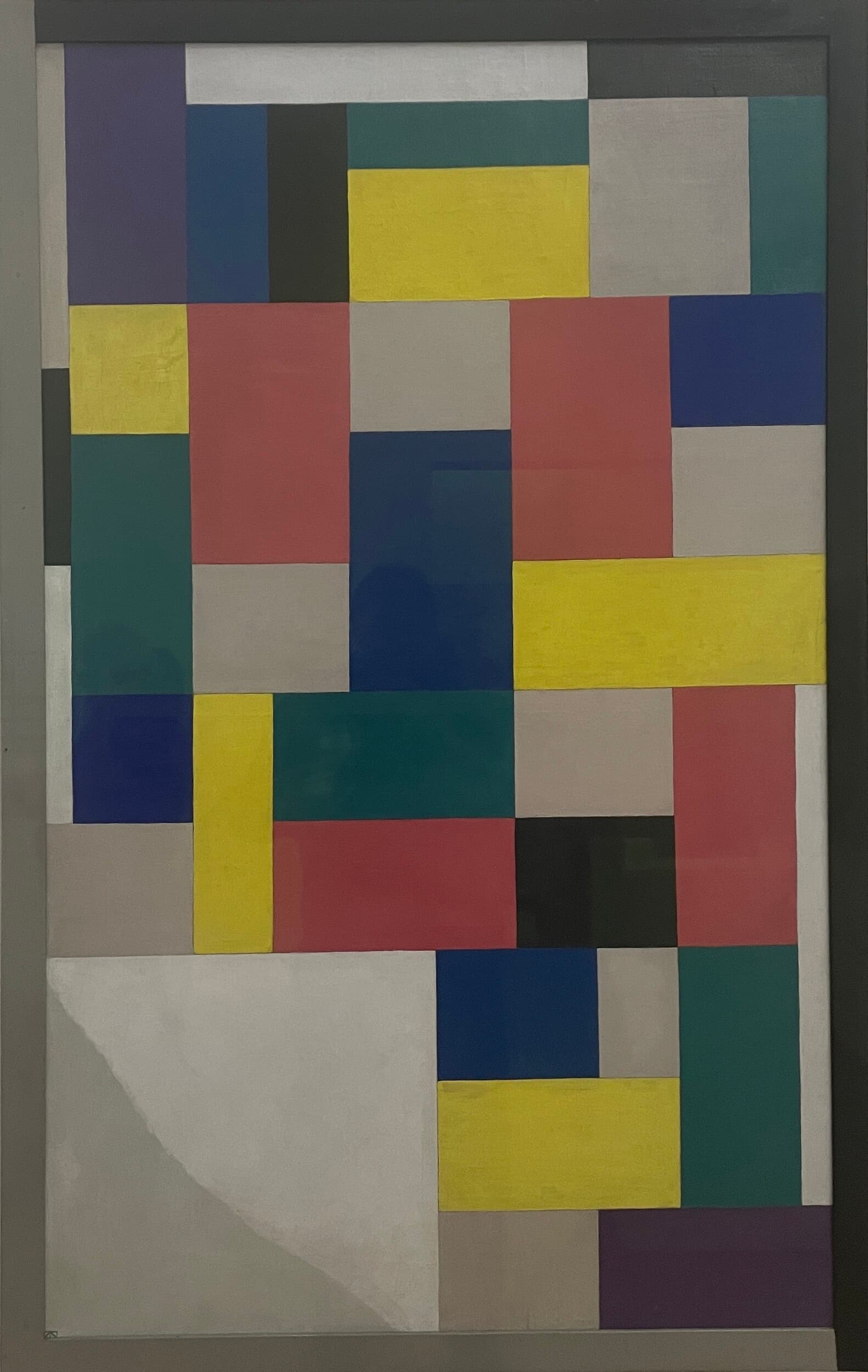
- Title: Pure Painting (Peinture pure)
- Artist: Theo van Doesburg (1883-1931)
- Date: 1920
- Made in: Leyde, Netherlands
- Medium: Oil on canvas and painted wooden frame
- Dimensions: 130 x 81 cm
- Location: Musée national d'art moderne, Centre Pompidou, Paris, France
- Photo credit: H.L.C. Jaffé (1983) Theo van Doesburg, Amsterdam, Meulenhoff/Landshoff on Wikipedia.org
Theo van Doesburg’s "Pure Painting", also known by its French title "Peinture pure", belongs to the De Stijl / Neoplasticism movement and represents van Doesburg’s attempt to create a completely non-representational, “pure” abstract composition using only geometric forms, flat color, and a grid structure.
Visually, the work is built from interlocking horizontal and vertical bands of color laid over a neutral gray ground. Rectangles and strips of primary colors (red, blue, yellow) are combined with black, white, and more muted tones, creating an asymmetrical but carefully balanced pattern. The eye moves around the canvas following these colored bars, which overlap and interweave, so that no single area dominates; instead, the whole surface feels like a continuous, rhythmic grid.
At the conceptual level, van Doesburg saw this painting as a culmination of his search for a fully “flat” composition, one in which the illusion of depth disappears and the focal point is effectively pushed outside the painting. Rather than depicting objects or space, he uses the grid to deny traditional perspective and to make each colored plane independent yet integrated into a unified whole. This idea reflects De Stijl theories of reducing art to elementary components—straight lines, right angles, and pure colors—to reach a universal, objective language of form.
The painting is also significant for the way it both follows and subtly disrupts its own system. In the bottom left corner, a large, vibrant white square appears slightly “unfinished,” interrupting the otherwise systematic repetition of colored bands; the original two-tone frame adds another small disturbance to the balance.
The website centrepompidou.fr explains "Pure Painting" marks an important milestone in van Doesburg’s evolution from strict Neoplastic grids toward the more dynamic experiments that would lead to his later diagonal “counter-compositions.”
--