Antonio da Correggio - Jupiter and Io (c.1533)
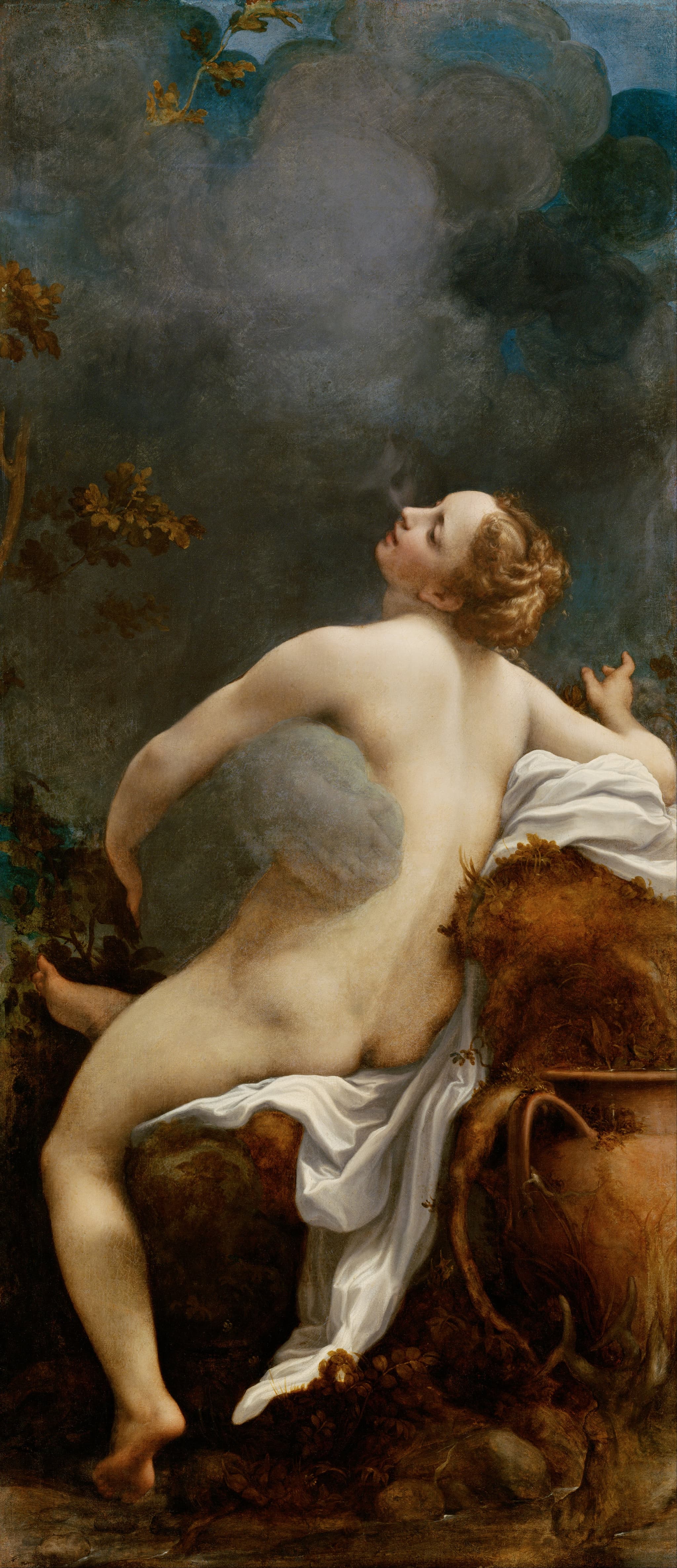
- Title: Jupiter and Io
- Artist: Antonio da Correggio (1489-1534)
- Date: c.1532-1533
- Made in: Mantua or Parma in Northern Italy
- Medium: Oil on canvas
- Dimensions: 164 × 71 cm
- Location: Kunsthistorisches Museum, Vienna, Austria
- Photo credit: Google Arts & Culture on Wikipedia in 2012
Antonio da Correggio’s "Jupiter and Io" shows the nymph Io in an ecstatic embrace with Jupiter, who has taken the form of a cloud. The tall, narrow canvas presents her seated on a bank, body twisted and arching as she leans back into a dense, dark vapor that wraps around her torso.
Her skin is rendered with Correggio’s characteristic softness and pearly light. Opposite this, Jupiter is almost entirely dematerialized: there is no solid body, only an arm emerging from mist pulling in Io by the waist and a suggestion of a face kissing Io's cheek. The contrast between Io’s tangible flesh and Jupiter’s amorphous form is the key visual tension of the painting.
The cloud itself is painted with extraordinary subtlety. At first glance it reads simply as a thick, smoky mass, but as you look more closely, Correggio lets features slowly appear: the faint profile of Jupiter’s face just above Io’s mouth, the hazy outline of a hand gripping her hip, fingers barely defined in a swirl of grey. The edges of the cloud are feathered and blurred, built up from very soft transitions of tone, so there is no clear contour. This gives the vapor a pillowy, almost tactile quality, as if atmosphere has condensed into something halfway between air and flesh. Light is handled so that some parts of the mist catch a gentle highlight while others sink into shadow, making the cloud feel three-dimensional without ever becoming a solid object. Small patches of blue sky around the mist remind us that this is broad daylight, which makes the darkness of the cloud even more striking: this is not normal weather but a supernatural manifestation. The cloud flows downwards toward Io’s lap and thigh, visually “pulling” her into the embrace and suggesting upward motion at the same time, as if she could be lifted and absorbed entirely.
On the bottom right, one can see the head of a cow. As the myth goes, Zeus turned Io into a cow to avoid his wife Hera finding out he was cheating on her.
In this painting Jupiter is almost pure weather as Correggio explores the limits of painting itself: how far can a figure dissolve into light and air and still be felt as a presence? The result is an inventive “cloud portrait”, where the erotic charge comes as much from the sensation of being enveloped by atmosphere as from the meeting of two bodies.
--