El Greco - The Penitent Magdalene (c.1576–1577)
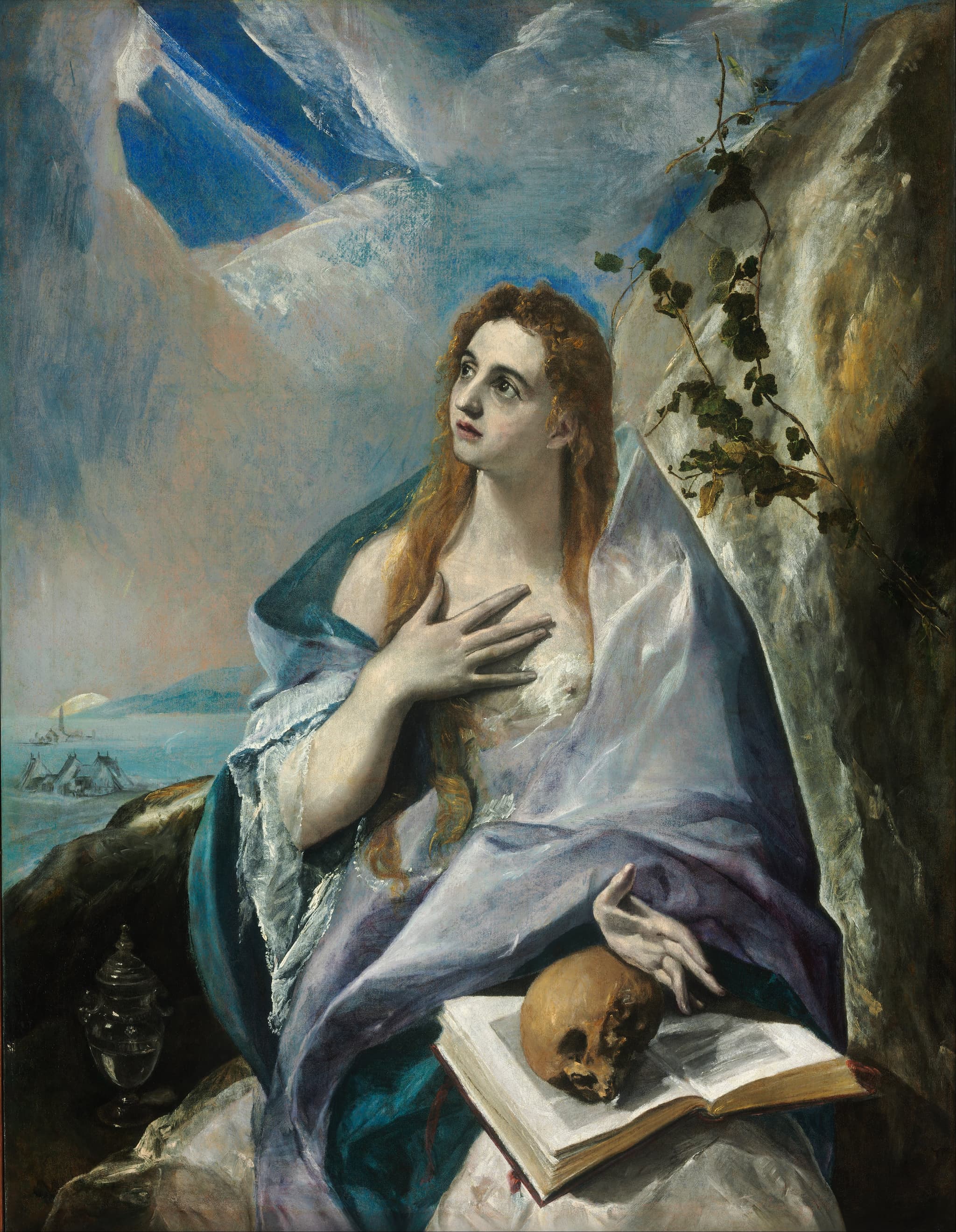
- Title: The Penitent Magdalene
- Artist: El Greco (Domenikos Theotokopoulos) (1541–1614)
- Date: c.1576–1577
- Made in: Toledo, Spain
- Medium: Oil on canvas
- Dimensions: 157 x 121 cm
- Location: Museum of Fine Arts, Budapest, Hungary (other versions include the Nelson-Atkins Museum of Art, Kansas City, USA)
- Photo credit: Google Arts & Culture on Wikimedia in 2012
"The Penitent Magdalene" is a religious painting by El Greco, created during his early years in Toledo, Spain. The work depicts Mary Magdalene, a biblical figure known for her repentance and devotion to Jesus. El Greco portrays her in a moment of deep contemplation and penitence, surrounded by symbolic elements such as a skull, a book, and an ointment jar, which represent mortality, knowledge, and her past life.
The painting is characterized by El Greco's distinctive style, featuring elongated figures, dramatic use of light and shadow, and a spiritual intensity that conveys Mary Magdalene's inner transformation. The composition reflects both the influence of Titian and Venetian Renaissance and El Greco's own innovative approach to religious themes.
"The Penitent Magdalene" is notable for its symbolic richness and emotional intensity. El Greco's use of dramatic lighting and bold contrasts highlights Mary Magdalene's inner struggle and spiritual awakening. The painting's composition, with its elongated figures and expressive gestures, creates a sense of movement and depth, drawing the viewer into the scene.
The painting includes some symbolic elements:
- Skull: Represents mortality and the transient nature of life.
- Book: Symbolizes knowledge and the scriptures.
- Ointment Jar: Refers to Mary Magdalene's past and her role in anointing Jesus.
- Light: Signifies divine grace and spiritual enlightenment.