Helene Schjerfbeck - Dancing Shoes (1882)
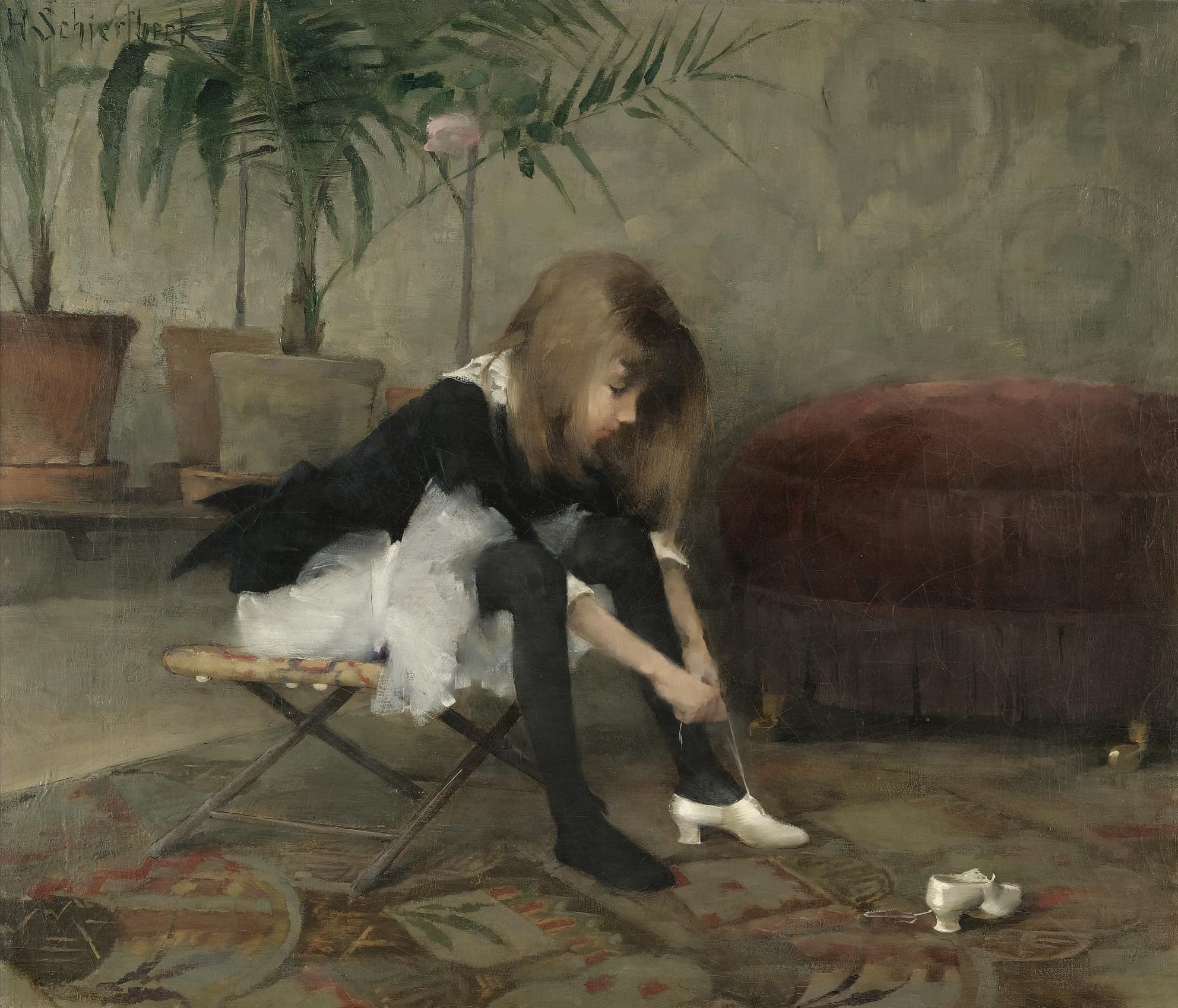
- Title: Dancing Shoes (Tanssiaiskengat)
- Artist: Helene Schjerfbeck (1862–1946)
- Date: 1882
- Made in: Finland
- Medium: Oil on canvas
- Dimensions: 55 x 65 cm
- Location: Unknow, in private collection (sold by Sotheby's in 2008)
- Photo credit: Sotheby's uploaded to Wikipedia by JVollenhoven in 2015
"Dancing Shoes" is an early work by Helene Schjerfbeck, a Finnish painter known for her realist and later modernist styles. This painting captures a girl putting on a pair of delicate dancing shoes.
The shoes are rendered with meticulous detail and a soft, naturalistic palette. Their pale color contrasts with the rest of the painting, mostly browns and grays. The position of one of the shoe in the middle of the painting adds to the central position given to the shoes.
Schjerfbeck shows here her ability to transform an everyday object into a compelling visual narrative is a hallmark of her work.
Helene Schjerfbeck is one of Finland's most celebrated artists, known for her realist portraits, still lifes, and later modernist works. She began her artistic training at a young age and quickly gained recognition for her technical skill and sensitivity to light and form. She was very much influenced by her time studying in France, particularly in Paris, and her admiration for Édouard Manet, Edgar Degas, Berthe Morisot, and Mary Cassatt.
The painting depicts her cousin Esther, who had extremely long and thin legs, exposed here with her dress up tp her hip. Those very thin legs has made viewers associate the painting with the nickname "Grasshopper". Schjerfbeck's use of soft lighting and delicate brushwork brings a sense of intimacy and nostalgia to the scene. The painting captures not just the physical details of the shoes, but also the implied stories and memories associated with them.
Her art often explores themes of isolation, memory, and the passage of time, making her a significant figure in Nordic art history.
References: