Paul Gauguin - Nativity (Nativité, Te tamari no atua) (1896)
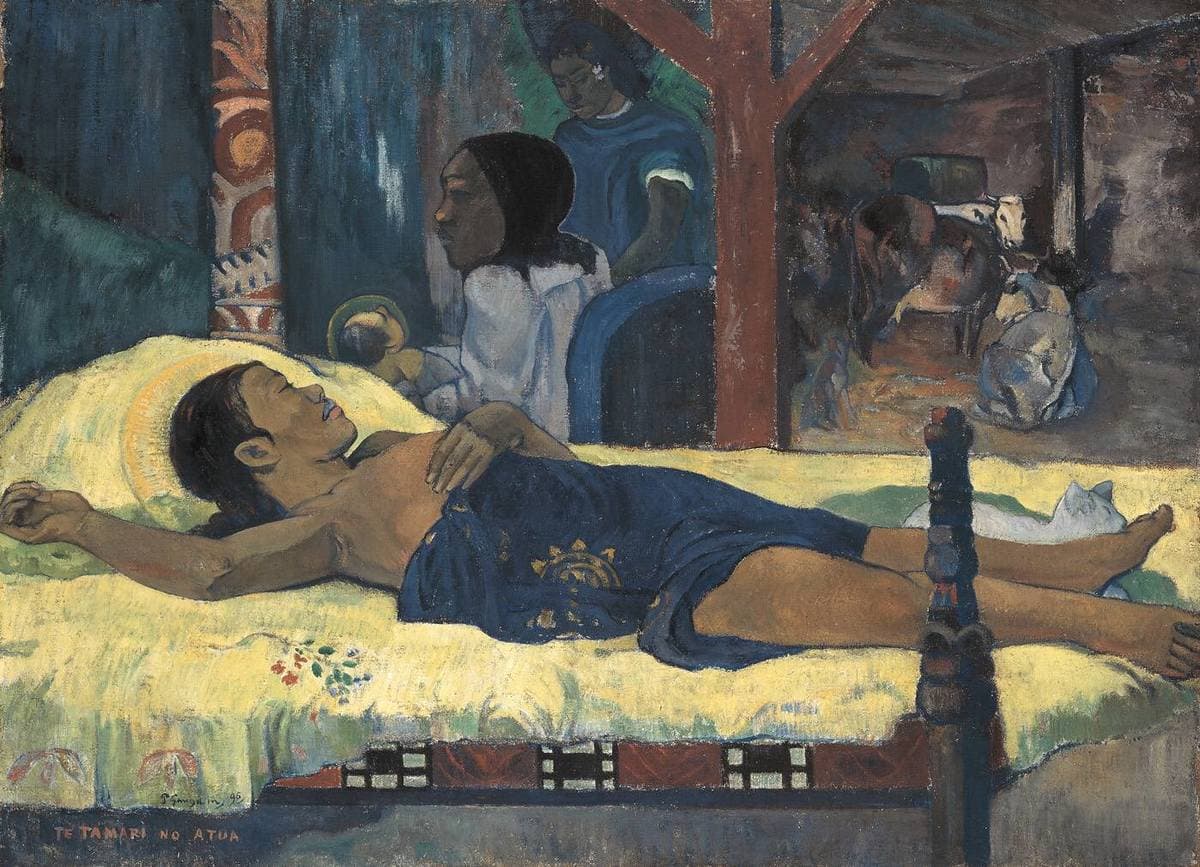
- Title: Nativity (Nativité, Te tamari no atua)
- Artist: Paul Gauguin (1848–1903)
- Date: 1896
- Made in: Tahiti, French Polynesia
- Medium: Oil on canvas
- Dimensions: 96.5 x 130.2 cm
- Location: Neue Pinakothek, Munich, Germany
- Credit line: Bayerische Staatsgemäldesammlungen
- Photo credit: Neue Pinakothek
"Nativité (Te tamari no atua)" is a deeply personal and symbolic painting by Paul Gauguin, created in 1896 during his second stay in Tahiti. The work reimagines the traditional Christian Nativity scene, blending it with Gauguin's own experiences and the cultural context of Tahiti. The painting features a Tahitian woman lying on a bed in the foreground, her gaze directed toward a seated woman holding a baby. The child and the seated woman are surrounded by halos, suggesting their divine significance.
The background includes an angel with green wings and cows, traditional elements of Nativity scenes.
The woman lying on the bed has a halo making her distinctly the Virgin Mary. And the child also has a halo making him distinctly the child Jesus.
However, Gauguin's depiction is not only about the birth of Christ, it also the birth and subsequent death of his daughter with his Tahitian companion, Pau'ura. The painting reflects Gauguin's grief and emotional turmoil, as well as his spiritual and artistic exploration of themes like birth, loss, and redemption.
The painting also reflects Gauguin's ambivalent relationship with Christianity and his fascination with Tahitian culture. By blending elements of the Nativity with his personal experiences, Gauguin creates a work that is both universal and deeply intimate, resonating with themes of birth, suffering, and hope.
- At Neue Pinakothek, Munich: Paul Gauguin - Nativity (Nativité, Te tamari no atua)
- On Wikipedia: Paul Gauguin