Paul Gauguin - Nevermore (1897)
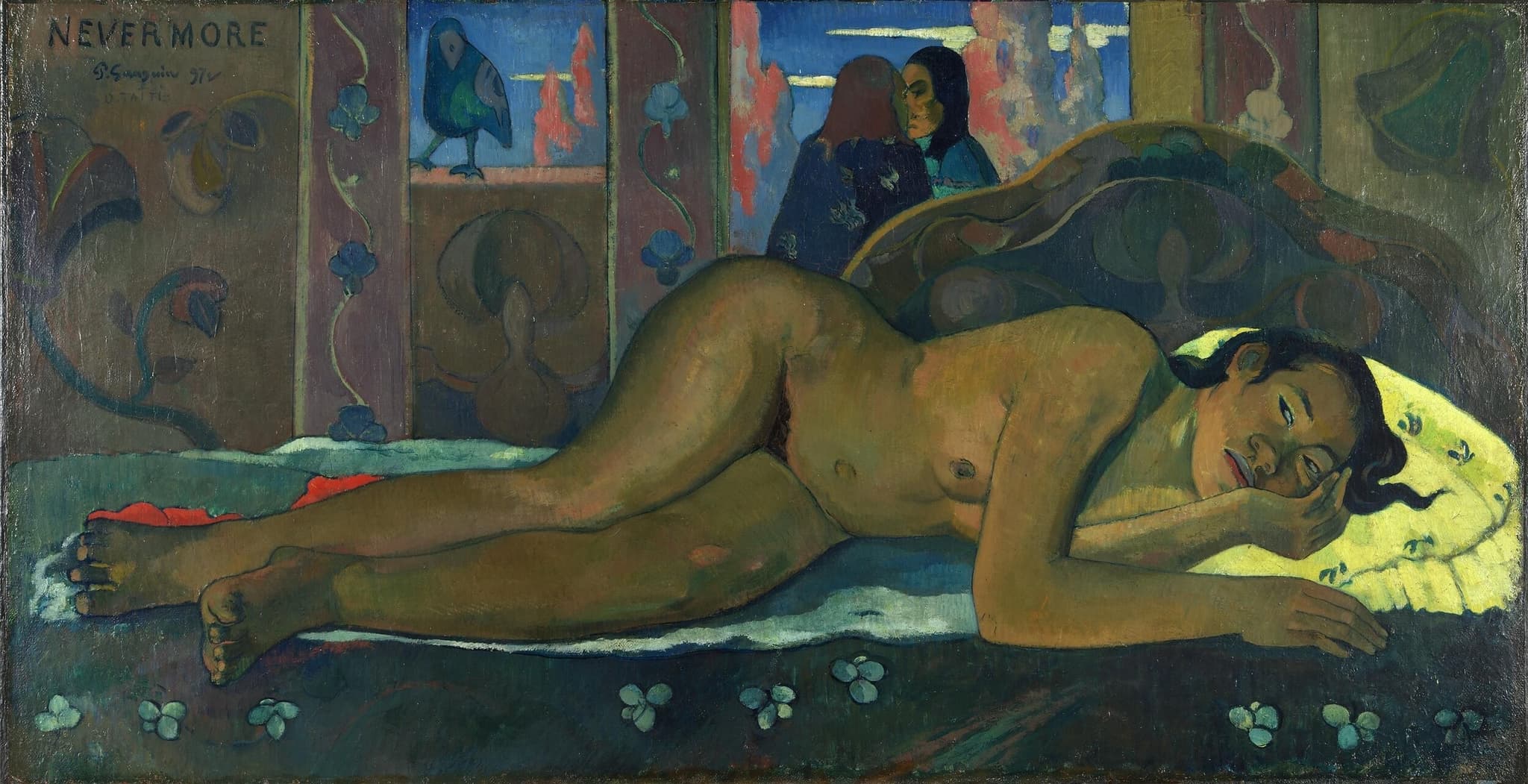
- Title: Nevermore (1897)
- Artist: Paul Gauguin (1848–1903)
- Date: 1897
- Made in: Tahiti, Pacific Ocean
- Medium: Oil on canvas
- Dimensions: 60.5 x 116 cm
- Location: Courtauld Institute of Art, London, UK
- Photo credit: The Courtauld (Samuel Courtauld Trust)
"Nevermore" is a powerful and enigmatic painting by Paul Gauguin, created during his second stay in Tahiti. The work portrays Pahura, Gauguin's young Tahitian companion, lying on a bed in a state of quiet melancholy. The composition is dominated by the curves of Pahura's body, the headboard, and the arabesque patterns on the wallpaper, all of which contribute to a dreamlike atmosphere.
In the background, a raven perches on a ledge, accompanied by two shadowy figures. The title "Nevermore" is inscribed in the upper left corner, a clear reference to Edgar Allan Poe's poem "The Raven", in which a raven repeatedly croaks the word "nevermore" to a grieving protagonist. Gauguin's painting captures a moment of loss and unease, reflecting both Pahura's grief over the death of her first child and Gauguin's own emotional turmoil, including the recent loss of his beloved daughter Aline in Europe.
Nevermore is celebrated for its innovative composition and symbolic richness. Gauguin's use of bold outlines, flattened forms, and vibrant colors creates a sense of both intimacy and unease. The painting's dreamlike quality blurs the line between reality and myth, inviting viewers to contemplate the emotional and cultural complexities of Gauguin's life in Tahiti.
The work is also significant for its exploration of the female nude in a non-Western context. Gauguin's portrayal of Pahura is both sensual and melancholic, reflecting his ambivalent attitudes toward Tahitian culture and his own role as an outsider. It has been widely analyzed for its themes of loss, colonialism, and cultural identity, and it continues to captivate audiences with its haunting beauty and layered meanings.