Anton Raphael Mengs - The Judgment of Paris (1757)
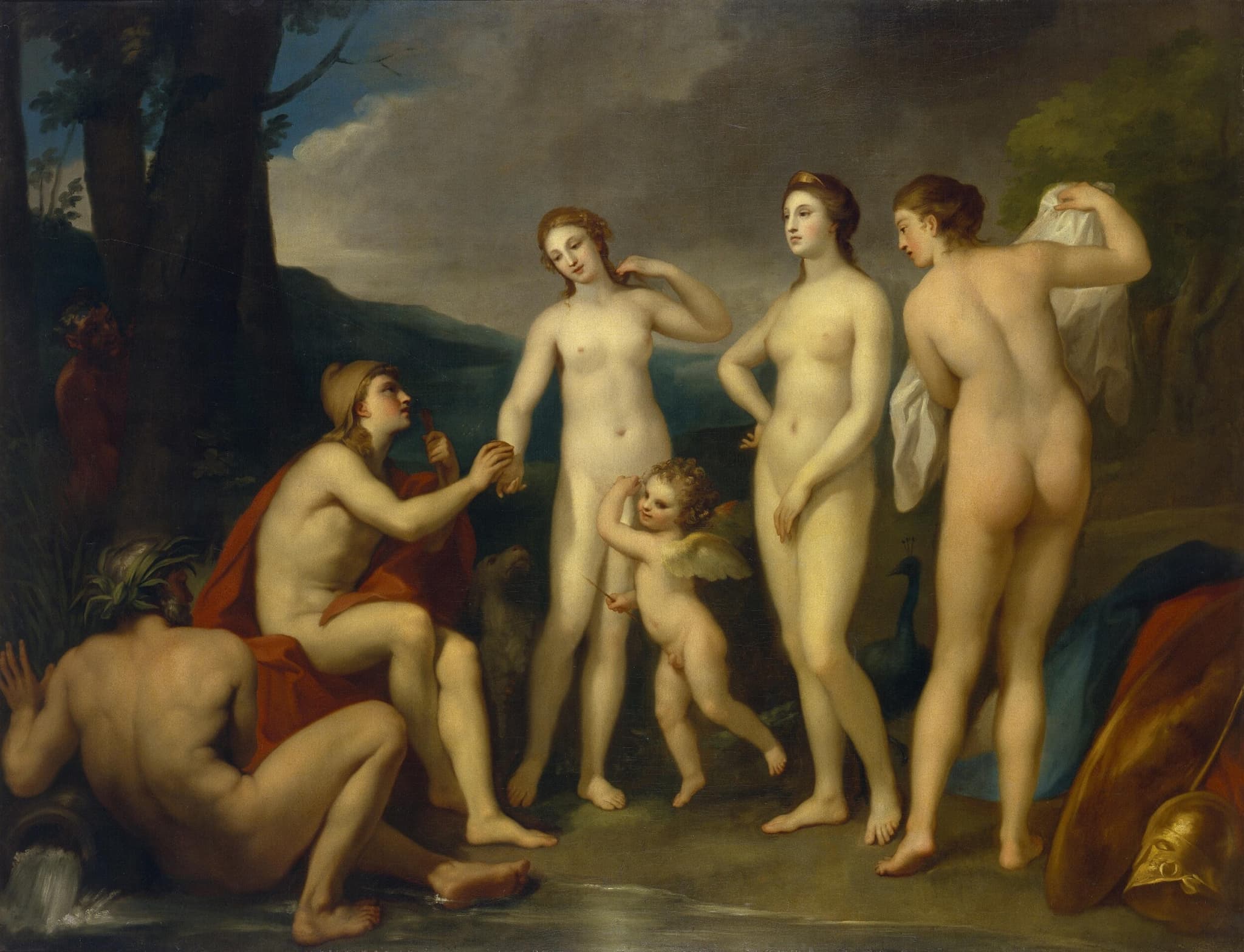
- Title: The Judgment of Paris
- Artist: Anton Raphael Mengs (1728-1779)
- Date: 1757
- Medium: Oil on canvas
- Dimensions: 226 x 296 cm
- Location: Hermitage Museum, Saint Petersburg, Russia
- Photo credit: Hermitage Museum
Anton Raphael Mengs' "The Judgement of Paris" captures a key moment from Greek mythology. This narrative unfolds the story of Paris, a Trojan prince, who is tasked with deciding who among the three goddesses-Hera, Athena, and Aphrodite—is the most beautiful, thus deserving the golden apple. Each goddess offers Paris a bribe, showcasing their divine attributes, leading to a dramatic choice with far-reaching consequences. Mengs captures the moment Paris chooses Venus by giving her the golden apple. Venus is given central stage: she is in the middle of the painting; the light is shining more on Venus than on theres; she wears a smile on her face while the two other goddesses look unsatisfied.
In this painting, Mengs employs a balanced composition that draws our eyes naturally through the figures. The three goddesses are centrally positioned, each exuding distinct characteristics reflective of their personalities: Hera’s regal grandeur, Athena’s wisdom, and Aphrodite’s captivating beauty. The use of light and shadow enhances the three-dimensionality of the figures, while the warm color palette evokes a sense of harmony and clarity typical of the neoclassical style.
The painting is rich in symbolism, emphasizing themes of beauty, choice, and the moral complexities of desire. The golden apple not only signifies a prize among the goddesses but also represents the fickleness of human nature—what one values can lead to chaos and conflict. Mengs subtly captures this tension through the expressions and postures of the characters, inviting viewers to ponder the weight of Paris's decision.
Mengs, often regarded as the pioneer of neoclassicism, bridges the gap between baroque drama and classical elegance. The Judgement of Paris is vital for its exploration of mythological themes within a contemporary context, influencing future artists who sought to combine the grandeur of the past with a modern sensibility.
--
- At Hermitage Museum: Anton Raphael Mengs - The Judgment of Paris
- On Wikipedia: Anton Raphael Mengs - Le jugement de Paris (in French)