Diego Velázquez - The Surrender of Breda (1634-35)
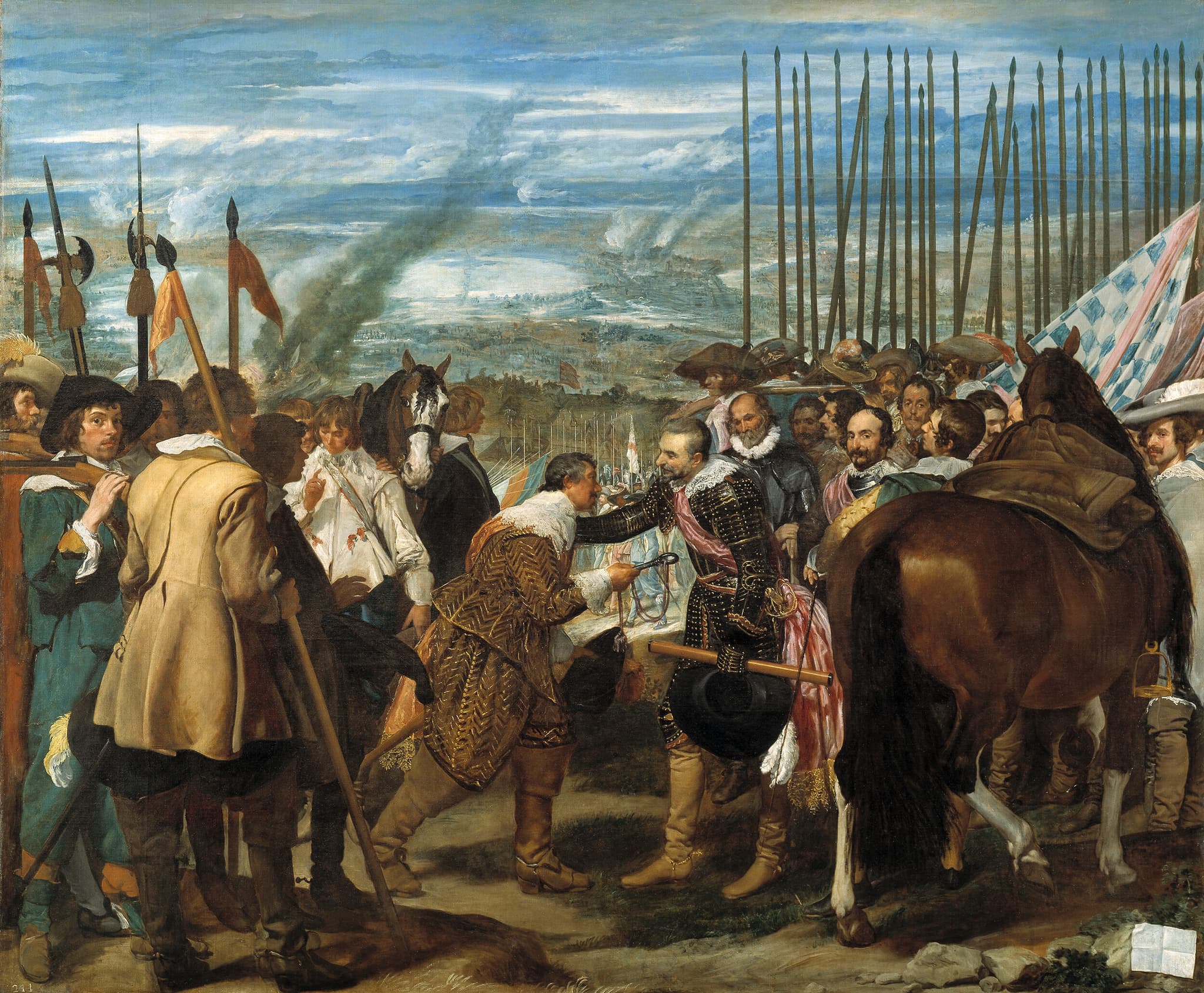
- Title: The surrender of Breda
- Artist: Diego Velázquez (1599-1660)
- Date: 1634-35
- Medium: Oil on canvas
- Dimensions: 307 x 367 cm
- Location: Museo del Prado, Madrid, Spain
- Photo credit: Museo del Prado, Madrid, Spain
Diego Velázquez’s "The Surrender of Breda", also called "The Lances", is a large, panoramic oil painting that captures the moment when the Dutch commander Justinus van Nassau hands the keys of the city of Breda to the Spanish general Ambrogio Spinola.
In the center of the composition, the two men lean toward each other in a surprisingly intimate gesture: Justinus bows slightly, while Spinola, having dismounted from his horse, reaches out to place a reassuring hand on his shoulder, preventing him from kneeling. Spinola is clearly depicted as the hero—distinguished by his ornate armor and sash and the compositional emphasis—but he is not aloof or triumphalist; his greatness lies in restraint and empathy.
Around them, Spanish troops stand in disciplined ranks to the right, their spears rising in a dense forest of verticals that gives the painting its alternative title, while the fewer, more disordered Dutch soldiers cluster at the left. Smoke in the distant background hints at the battle that has just taken place, but Velázquez keeps the violence offstage and focuses instead on this courteous exchange.
Historically, the painting commemorates the 1625 surrender of the fortified Dutch city of Breda during the Eighty Years’ War, the long struggle in which the Dutch sought independence from Spanish Habsburg rule. Spinola’s real-life treatment of the defeated, allowing the Dutch garrison to withdraw honorably with flags and arms, was remembered as unusually generous, and Velázquez builds the entire image around this idea of magnanimity. The work was painted about a decade later for King Philip IV of Spain as part of a cycle of large battle pictures to decorate the Hall of Realms in the Buen Retiro Palace, a ceremonial space meant to impress visiting ambassadors with Spain’s military glory and the king’s virtues. In that context,"The Surrender of Breda" does double duty: it celebrates a Habsburg victory while projecting an image of Spain as noble and chivalrous rather than merely brutal.
Other history paintings that have similarities with this one include:
- Paolo Uccello's The Battle of San Romano;
- Titian’s "Allocution of the Marquis del Vasto" with lances in the background;
- Jacques-Louis David’s "Oath of the Horatii".
Velázquez’s canvas is not only a masterpiece of Spanish Baroque painting but also a pivotal reimagining of what a victory picturecan be: a meditation on mercy, honor, and the fragile humanity of both winners and losers.
--