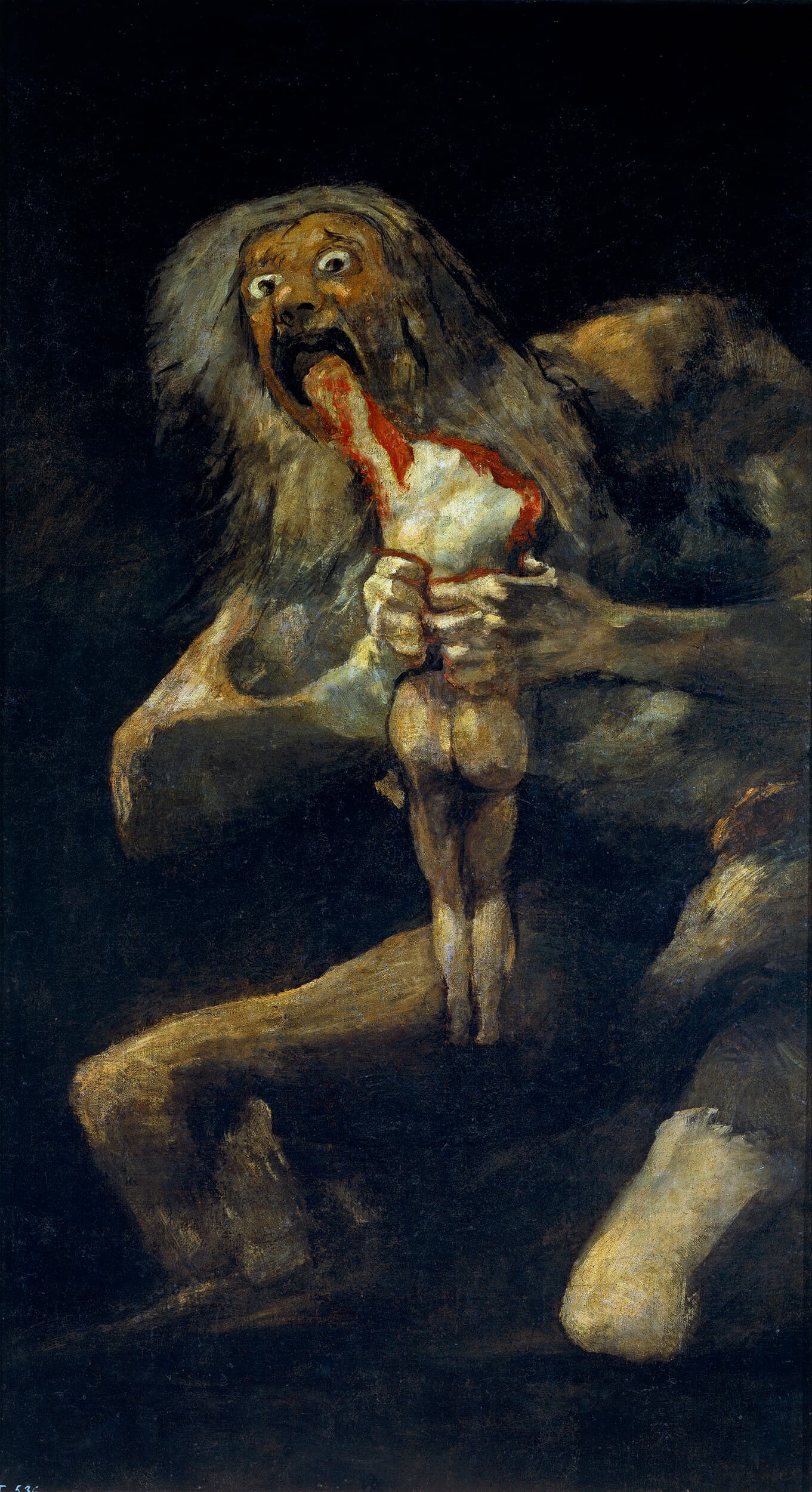
Francisco de Goya y Lucientes - Saturn Devouring His Son (c.1819–23)
- *Title: Saturn Devouring His Son (Saturno devorando a su hijo)
- *Artist: Francisco de Goya y Lucientes (1746-1828)
- *Date: c.1819–23
- Created in: Quinta del Sordo, near Madrid, Spain
- Medium: Mixed technique on canvas
- Dimensions: 146 × 83 cm
- Location: Museo del Prado, Madrid, Spain
- Photo credit: Museo del Prado on Wikipedia
When you look at Goya’s "Saturn Devouring His Son", you’re confronted with something deliberately shocking. In the center of a dark, undefined space stands the god Saturn, enormous and wild-eyed, clutching the half-eaten body of his child. There’s no decorative background, no mythological setting—just this brutal act, lit as if by a sudden flash of light in a black room. It feels less like a distant myth and more like walking in on a nightmare.
If you focus on Saturn himself, his body seems distorted and almost inhuman. His shoulders are hunched, his spine twisted, his hands like claws digging into the flesh. The most disturbing part is his face: eyes wide and staring, mouth stretched in a kind of desperate bite rather than a triumphant one. He doesn’t look powerful or majestic; he looks terrified, driven by a primitive fear that his children will overthrow him, as the myth tells us.
The color palette is very simple and very effective. Goya uses deep blacks and browns for the background, which swallow up any detail and make the figure stand out. Saturn’s skin is pale, almost corpse-like, smeared with red where the blood runs. The white and red of the body against the darkness create a violent contrast that keeps your eyes locked on the horror of the scene. There is no gentle transition, no softening of the violence.
This was painted late in Goya’s life, directly on the walls of his house, part of his “Black Paintings.” It reflects deep anxieties: fear of aging, fear of losing power, fear of the cruelty humans (and gods) can show. The painting is unsettling on purpose, asking you to feel that mixture of fascination and repulsion—and to wonder what dark impulses might exist in all of us.
Goya's painting shares the same theme as a painting by [Rubens' Saturn] (https://www.enjoyart.org/blog/rubens-saturn), as the central figure is acting out of madness rather than calculating reason, and the consumed figure is completely lifeless rather than in clear pain. Goya had likely seen Rubens' version before painting his own.
--
- At Museo del Prado: Francisco de Goya y Lucientes - Saturn devouring his son
- On Wikipedia: Francisco de Goya y Lucientes - Saturn devouring his son