Jacques-Louis David - Love and Psyche (1817)
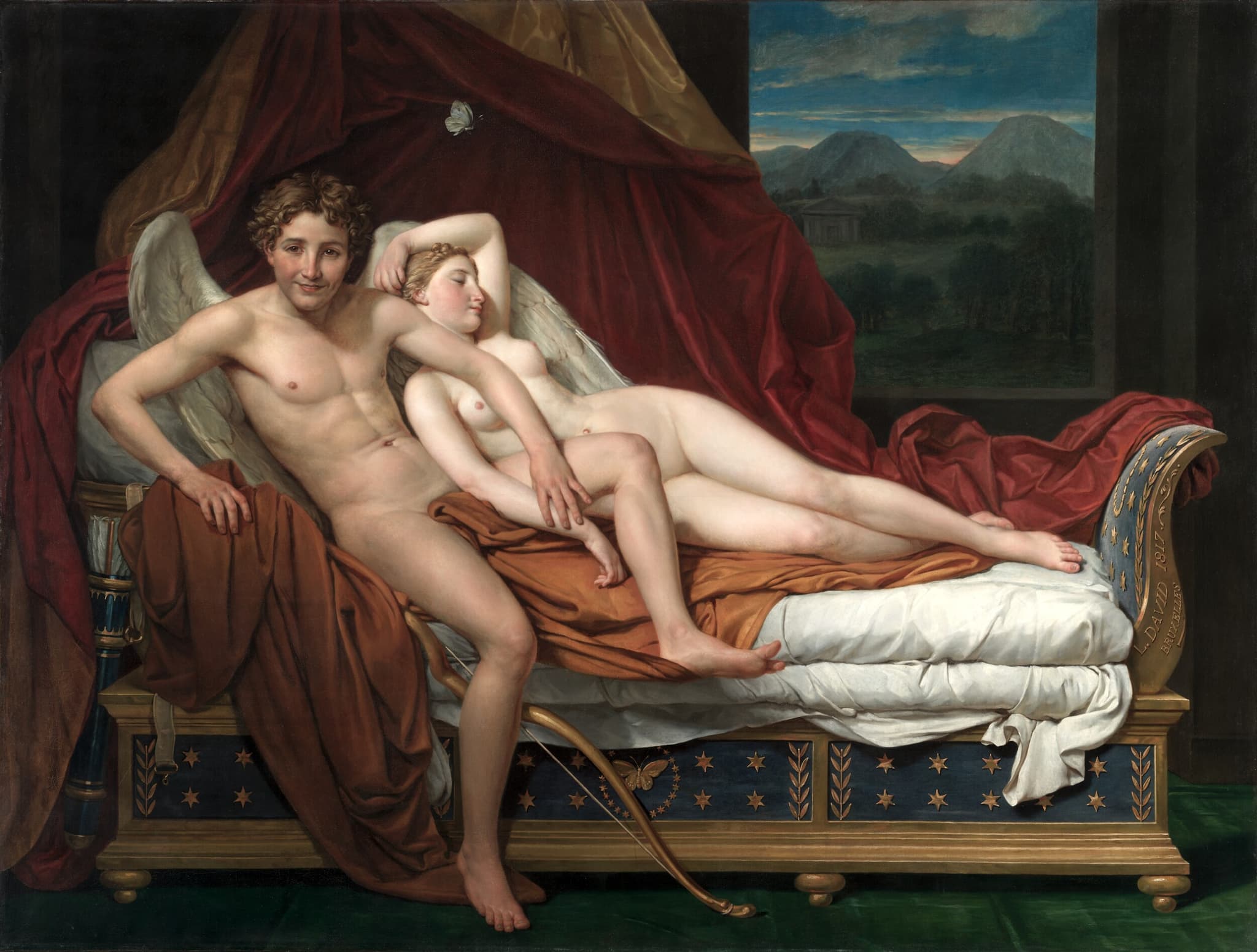
- Title: Love and Psyche
- Artist: Jacques-Louis David (1748-1825)
- Date: 1817
- Medium: Oil on canvas
- Dimensions: 184 x 242 cm
- Location: Cleveland Museum of Art, Ohio, USA
- Credit line: Leonard C. Hanna Jr. Fund
- Photo credit: clevelandart.org on Wikimedia
David’s "Love and Psyche", also known as "Cupid and Psyche", represents Cupid, the god of love and eroticism, in bed with the beautiful mortal Psyche. The painting explores the ambivalence between idealized love and physical relationship, between sacredness versus human. David represents Psyche as a pure and perfect young woman, while Cupid is depicted as a candid teenager, very human-like and happy of his sexual conquest.
The painting's setting is an Empire-style bedroom. Psyche is lying naked and asleep on a luxurious bed, her body stretched out in a classic reclining pose on top of white and orange draperies. At the edge of the mattress is sitting Cupid, an adolescent boy with wings. He is getting out of bed, delicately lifting her arm up to release his thigh. Cupid is looking at the viewer ; it is as if he were sharing a moment with the viewer as he sneaks away.
Their bodies are sharply lit against the deep reds, greens and browns of the room, so the eye jumps immediately from her vulnerable, luminous body to his sharp profile and tense posture.
Behind the bed with its heavy drapery, a windw open a cool blue landscape opens out in the distance, a visual contrast that has been read as a symbol of journey, renewal, and freedom that Psyche does not yet have. A tiny butterfly hovers above her head, Psyche’s traditional attribute and, in some interpretations, a sign of both death and transcendence—hinting at the trials she will undergo before the lovers are finally reunited.
What took David’s contemporaries aback was how human Cupid looks. He is depicted as a beautiful, young man with very human traits not as a detached figure with marble-smooth, angelic youth.
The theme of Cupid and Psyche has beed explored many times in art history and most usually Cupid is represented idealized either as a cherub or as a young god: toned body, flawless skin, lack of distinctive features, lack of expression other than bliss.
Contemporary representations of Cupids responding to classical, god-like cannons include:
Cupid and Psyche (or Allegory of Eros and Psyche is an oil-on-canvas painting by French painter François Gérard, from 1798. The young princess Psyche is depicted here as being somewhat surprised by the first kiss she is receiving from Cupid, which remains invisible to her eyes. Cupid is here represented in an androgynous way, he is painted like a delicate piece of porcelain.
The painting Love and Psyche by François Édouard Picot, now part of the Musée du Louvre in Paris, France, was painted in 1817, the same year as David's "Cupid and Psyche". It is also similar in composition with Empire-style furnishing, ruffled draperies, Cupid leaving the bed, a flush landscape in the background, etc. The way Cupid is represented however is radically different: whereas David made his Cupid human like, Picot's Cupid is vaporous and idealized.
Another example of conventional classical treatement of Cupid is Antonio Canova’s famous marble group finished in 1793, Psyche Revived by Cupid's Kiss. The marble group shows the moment when Psyche, collapsed in a deathlike sleep, is brought back to life by Cupid. She has just awakened and twists upward from a rocky base, arms raised to encircle Cupid’s head. He kneels over her, wings spread in a soft arc, one arm supporting her shoulders, the other gently lifting her head toward his kiss. Both Cupid and Psyche are represented as nubile, idealized beauties.
Interestingly, if we look more in the past though, we can find inspirations to David's choice of a human like representation of Cupid:
Caravaggio's Amor Vincit Omnia from 1602
Orazio Gentileschi's "Cupid and Psyche" from late 1610s
David is setting up a jarring contrast between Psyche’s ideal, Titian- and Correggio-like reclining beauty and a very mortal, morally ambiguous Cupid. The painting becomes less a sweet love scene and more a commentary on youth, fun, desire...
--