Peter Paul Rubens - The Tiger Hunt (1618)
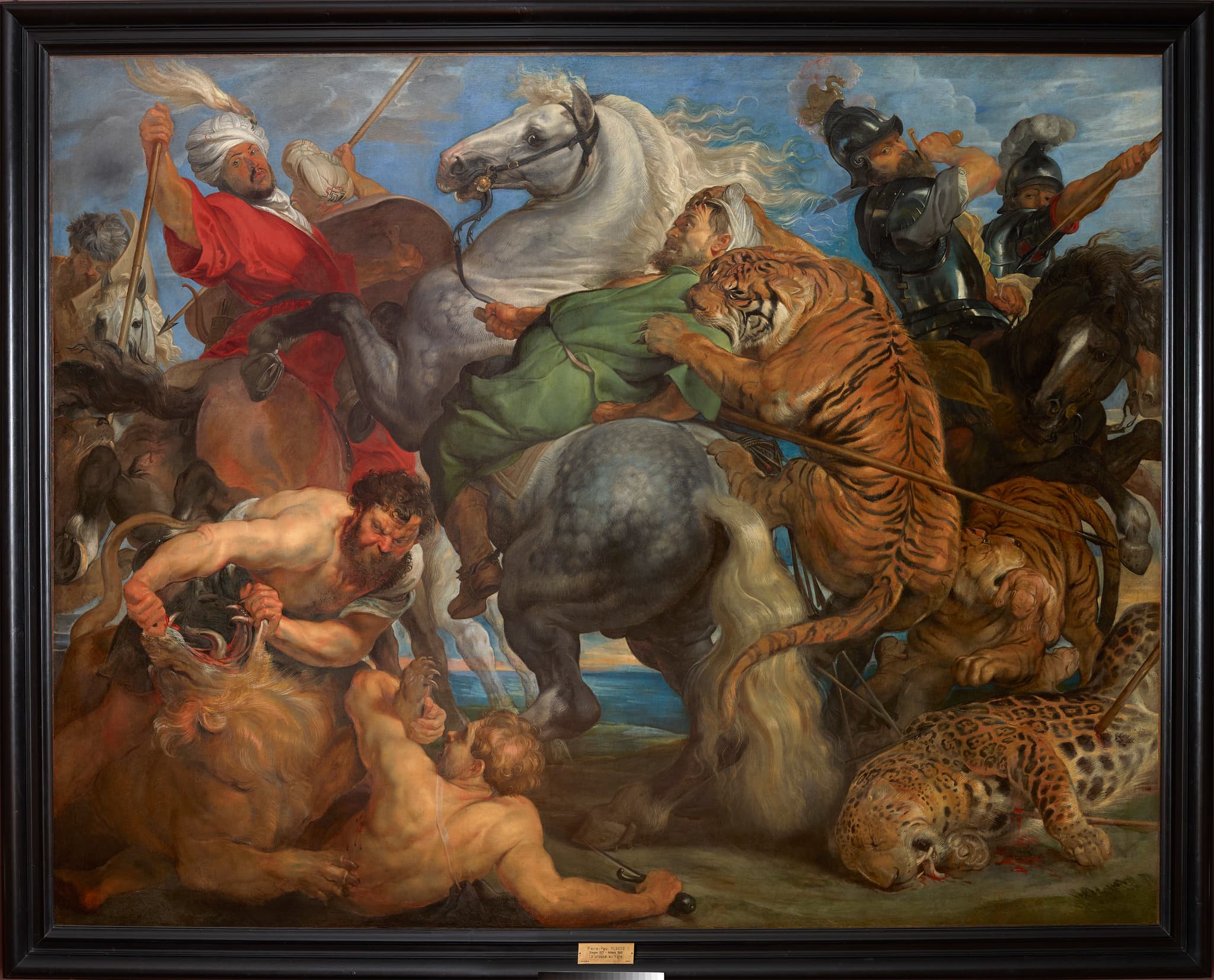
- Title: The Tiger Hunt
- Artist: Peter Paul Rubens (1577-1640)
- Date: 1618
- Made in: Antwerp, Belgium
- Medium: Oil on canvas
- Dimensions: 253 x 319 cm
- Location: Museum of Fine Arts , Rennes, France
- Photo credit: Jean-Manuel Salingue on mba.rennes.fr
Rubens’s Tiger Hunt feels like the wall explodes into wild movement. The painting is over 3 meters wide, so when you get close to it, it like a movie screen packed with people, horses, and big cats all tangled together. There’s no calm, empty space; everything is twisting, turning, and crashing into everything else. Rubens wants you to feel as if you’ve walked into the middle of a very dangerous moment, just one second before something terrible—or heroic—happens.
In the center: a magnificent tiger springs onto a rearing horse, its claws dug into the animal’s back, its teeth bared. You can almost hear the horse screaming and feel the tiger’s fur rippling as it leaps. Around them, hunters in bright clothes and shining armor are trying to fight back. One man swings a spear, another is falling to the ground, and a leopard lies stretched out in the corner, as if it has already been defeated. Rubens paints muscles—human and animal—with such care that you can see how incredibly strong every body is, fighting for survival.
Rubens uses color and light to guide your eyes. He splashes brilliant orange on the tiger’s fur, glowing red on a hunter’s cloak, and sharp white on the horses so they stand out against the darker shadows. Your gaze races from face to face, paw to hoof, sword to claw. There is no “safe” place to rest your eyes, so you feel the same panic and energy as the people in the scene. It’s a bit like riding a roller coaster with your eyes—you’re thrown around, but you can’t look away.
The “Tiger Hunt” is one of four hunting scenes commissioned by Maximilian I of Bavaria in 1615. Rubens painted it after an eight-year stay in Italy (1600-08) where he was very influenced by Baroque masters such as Titian, Tintoretto, and Caravaggio. The painting draws very probably from Leonardo da Vinci’s never-completed fresco, the “Battle of Anghiari”, which Rubens had made a drawing of. The energy, violence and pain that can be seen in the human and animal faces and bodies in Rubens’ painting are uncharacteristic of paintings of the time.
This painting is not really about hunting ; it’s about power, courage, fear, and the thin line between being in control and losing it. Rubens turns a hunt into a giant stage where humans and animals are equally fierce and vulnerable. If you stand in front of it long enough, you might start to imagine what happens next: does the hunter save the horse, does the tiger break free, or does everyone tumble to the ground in a whirlwind of fur and steel?
--
- At Musée des Beaux Arts de Rennes: Peter Paul Rubens - The Tiger Hunt
- On Wikipedia: Peter Paul Rubens - The Tiger Hunt