François Édouard Picot - Love and Psyche (1817)
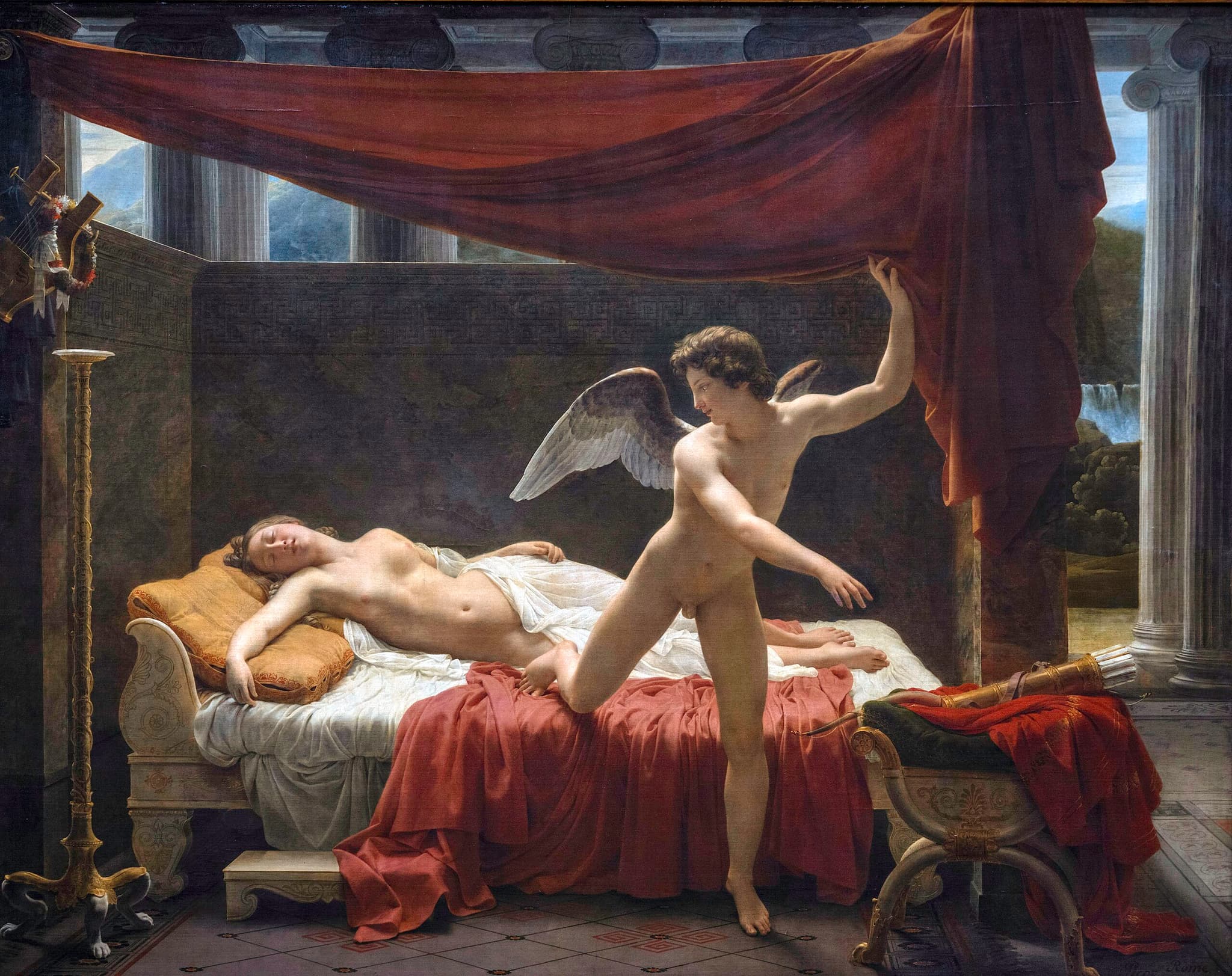
- Title: Love and Psyche (L'Amour et Psyché)
- Artist: François Édouard Picot (1786-1868)
- Date: 1817
- Made in: Rome, Italy
- Medium: Oil on canvas
- Dimensions: 233 x 291 cm
- Location: Le Louvre, Paris, France
- Photo credit: Photo credit: Wilfredor on Wikimedia in 2024
François-Édouard Picot’s "Love and Psyche" is a large, horizontal Neoclassical canvas painted in Rome. On a sumptuous bed, Psyche lies nude and deeply asleep, her body softly lit and framed by white sheets and warm drapery. Cupid—an idealized young man with delicate wings—is rising from the bed. He turns back toward her with a tender, lingering gaze as he steps away, arm extended toward his bow and quiver.
Picot chooses a quiet, secretive moment from Apuleius’s tale: Cupid must visit Psyche only at night, and she is forbidden to see his face. Here, the psychological drama is entirely in the body language. Psyche’s relaxed pose suggests absolute trust; Cupid’s backward glance mixes desire, protectiveness, and unease, aware that their happiness is fragile. The hushed bedroom, the heavy curtain, and the soft, evening light all reinforce the sense of a love affair suspended between bliss and impending discovery.
Stylistically, the painting is a model of French Neoclassicism: smooth, polished surfaces, precise drawing, and ideal proportions. Its sensual atmosphere and emotional nuance connect it to François Gérard’s "Cupid and Psyche". The idealization of Cupid contrasts greatly with the harsher realism of contemporary Jacques-Louis David’s "Love and Psyche".
The painting was exhibited at the 1819 Salon, Picot’s work won a first-class medal and was soon acquired by Louis-Philippe, launching the painter’s official career.
--